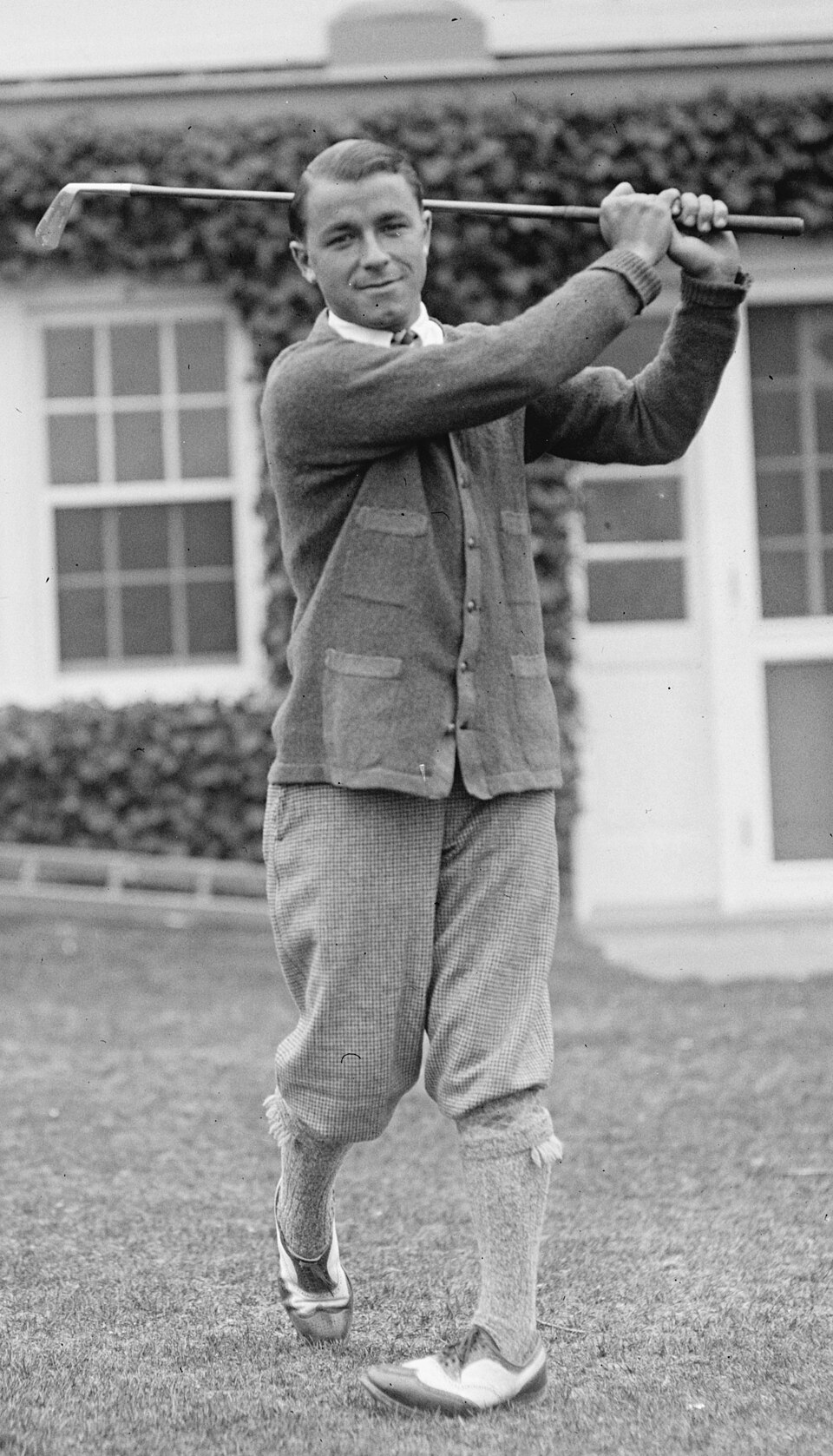
Gene Sarazen
Seve Ballesteros
Stat by stat
Bars are scaled to the leader in this list.
The verdict
Gene Sarazen leads 2 of 3 categories. Our all-time ranking places Gene Sarazen at #10 and Seve Ballesteros at #11.
Head-to-head FAQ
Who leads more shared metrics?
How do the published ranks compare?
Are these live stats?
The case for Gene Sarazen
Gene Sarazen, the son of an immigrant carpenter, was the first player to win all four of the modern professional majors, completing the career Grand Slam in 1935. He won 7 majors in total, including two U.S. Opens, three PGA Championships and the 1935 Masters, and 39 PGA Tour events across a career that began in 1920. That Masters victory featured the shot heard round the world, a holed 4-wood for an albatross two on the 15th that forced a playoff he went on to win. Sarazen also changed the game's equipment forever by inventing the modern sand wedge in 1932, adding a flange that let the sole bounce through sand rather than dig, a design principle still used in every wedge made today, and one of golf's most important innovations.
The case for Seve Ballesteros
Severiano Ballesteros was the most thrilling and imaginative player of his generation, a Spaniard whose flair reignited European golf. He won 5 majors, three Open Championships and two Masters, and more than 90 titles worldwide, including 50 on the European Tour, a tour record. Famous for wild drives and miraculous recoveries, Seve seemed to score from places no one else could reach, an artist of the short game and improvisation who turned trouble into birdies. Beyond his own victories he was the emotional engine of Europe's Ryder Cup revival, inspiring the breakthrough triumphs of 1985 and 1987 that ended American dominance, and later captaining the winning 1997 side at Valderrama in his native Spain. He died in 2011 at the age of 54, mourned across the game as the very soul of modern European golf.