At a glance
Curling · The culture is as distinctive as the rulesThe culture is as distinctive as the rules. Curlers call their own…
Curling · Why do curlers sweep the ice in front of the stone?Sweeping briefly melts the frozen droplets, called pebble, that cover a…
Curling · What is the hammer and why does everyone talk about it?The hammer is the last stone of an end, and having it is worth roughly a…
Curling · Why does a curling stone curl?Because it is released with a slow rotation, two or three turns over its…
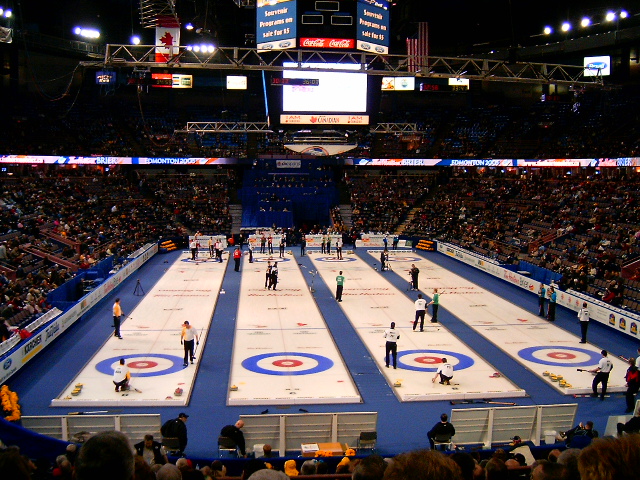
Sweeping briefly melts the frozen droplets, called pebble, that cover a curling sheet, creating a microscopic film of water that reduces friction under the stone. Two things follow. The stone travels further, by several metres if it is swept hard for its whole journey, and it curls less, holding a straighter line.
Curling · The culture is as distinctive as the rules
The culture is as distinctive as the rules. Curlers call their own infractions, concede when a game is beyond saving rather than play it out, and traditionally buy the opposition a drink afterwards, a code written down as the Spirit of Curling and still printed at the front of the rulebook.
Curling · Why do curlers sweep the ice in front of the stone?
Sweeping briefly melts the frozen droplets, called pebble, that cover a curling sheet, creating a microscopic film of water that reduces friction under the stone. Two things follow. The stone travels further, by several metres if it is swept hard for its whole journey, and it curls less, holding a straighter line.
Curling · What is the hammer and why does everyone talk about it?
The hammer is the last stone of an end, and having it is worth roughly a point at elite level because you get to react to everything the opposition has already done. It is decided before the game by the last stone draw, where each team throws to the button and the closer average wins, and after that it goes to whichever team did not score in the previous end.
Curling · Why does a curling stone curl?
Because it is released with a slow rotation, two or three turns over its whole 30-metre journey, and that rotation makes it drift sideways by about a metre. The strange part is the direction: a clockwise-rotating stone curls to the right, which is the opposite of what a spinning ball does on a table.
This is a reading check for the atlas, not personal advice, a live price, or a booking. It does not replace the full topic page.
Questions
- What is the next question after this?
- The hammer is the last stone of an end, and having it is worth roughly a point at elite level because you get to react to everything the opposition has already done. It is decided before the game by the last stone draw, where each team throws to the button and the closer average wins, and after that it goes to whichever team did not score in the previous end.
- Does this page rank people or nations?
- This is a reading check for the atlas, not personal advice, a live price, or a booking. It does not replace the full topic page.
- Where is the longer entry?
- Because it is released with a slow rotation, two or three turns over its whole 30-metre journey, and that rotation makes it drift sideways by about a metre. The strange part is the direction: a clockwise-rotating stone curls to the right, which is the opposite of what a spinning ball does on a table.
Next question: Road Cycling · Open the topic: Curling
⚽ How to read the GOAT score — Soccer (2022) · 🏀 When peak versus career changes the order — Basketball (1946) · 🎾 What a fair head-to-head holds constant — Tennis (1968) · ⚾ How a rules card differs from a record — Baseball (1903) · 🏎️ Which years the era window includes — F1 (1950) · ⛳ A shared prize versus one name — Golf (1860) · How to read a sports comparison