At a glance
Gymnastics · How old do you have to be to compete at the Olympics?Women must turn 16 during the calendar year of the competition and men must…
Gymnastics · What does it mean when a skill is named after a gymnast?The Code of Points catalogues every recognised element, and a gymnast who…
Gymnastics · What are the twisties?The twisties are a sudden loss of air awareness in which a gymnast cannot…
Gymnastics · How does the Olympic team competition work?Teams of five gymnasts compete in qualification, where four perform on each…
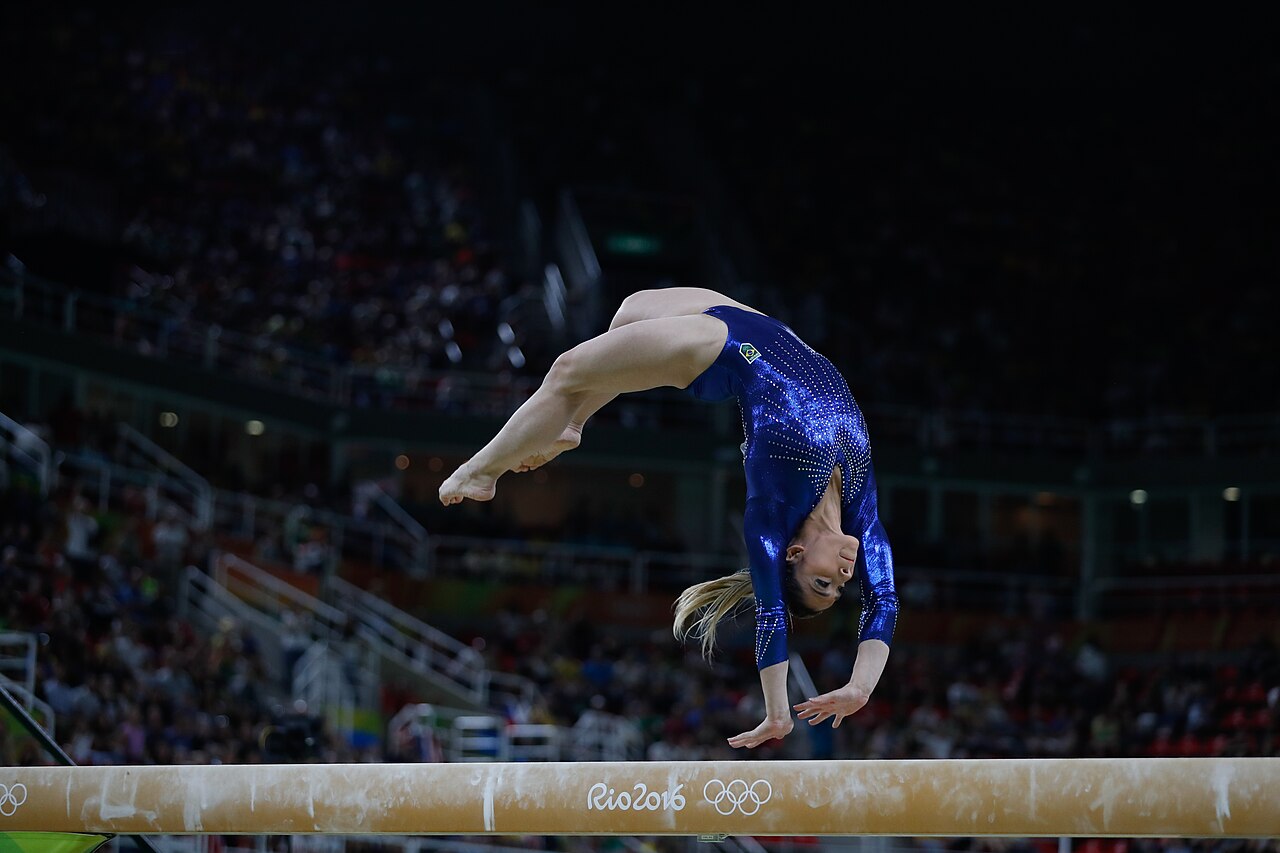
The Code of Points catalogues every recognised element, and a gymnast who invents a genuinely new one can have it entered under their own name permanently. The requirements are strict: the element must be submitted to the FIG technical committee in advance, and it must be performed successfully in qualification at a World Championships or Olympic Games, without a fall or a major error.
Gymnastics · How old do you have to be to compete at the Olympics?
Women must turn 16 during the calendar year of the competition and men must turn 18. The women's minimum was raised from 15 to 16 in 1997, after decades in which teenagers as young as 14 won Olympic titles — Nadia Comaneci was 14 when she won the 1976 all-around, a record now permanently unbreakable.
Gymnastics · What does it mean when a skill is named after a gymnast?
The Code of Points catalogues every recognised element, and a gymnast who invents a genuinely new one can have it entered under their own name permanently. The requirements are strict: the element must be submitted to the FIG technical committee in advance, and it must be performed successfully in qualification at a World Championships or Olympic Games, without a fall or a major error.
Gymnastics · What are the twisties?
The twisties are a sudden loss of air awareness in which a gymnast cannot sense where their body is during rotation. Twisting skills are performed almost entirely on proprioceptive memory built through thousands of repetitions, and when that mapping breaks down the athlete may over-rotate, under-rotate or freeze mid-air.
Gymnastics · How does the Olympic team competition work?
Teams of five gymnasts compete in qualification, where four perform on each apparatus and the best three scores count. The eight highest-ranked teams advance to the final, which is contested three-up, three-count: only three gymnasts perform on each apparatus and every single score is added, with no drop score to absorb a mistake.
This is a reading check for the atlas, not personal advice, a live price, or a booking. It does not replace the full topic page.
Questions
- What is the next question after this?
- The twisties are a sudden loss of air awareness in which a gymnast cannot sense where their body is during rotation. Twisting skills are performed almost entirely on proprioceptive memory built through thousands of repetitions, and when that mapping breaks down the athlete may over-rotate, under-rotate or freeze mid-air.
- Does this page rank people or nations?
- This is a reading check for the atlas, not personal advice, a live price, or a booking. It does not replace the full topic page.
- Where is the longer entry?
- Teams of five gymnasts compete in qualification, where four perform on each apparatus and the best three scores count. The eight highest-ranked teams advance to the final, which is contested three-up, three-count: only three gymnasts perform on each apparatus and every single score is added, with no drop score to absorb a mistake.
Next question: Handball · Open the topic: Gymnastics
⚽ How to read the GOAT score — Soccer (2022) · 🏀 When peak versus career changes the order — Basketball (1946) · 🎾 What a fair head-to-head holds constant — Tennis (1968) · ⚾ How a rules card differs from a record — Baseball (1903) · 🏎️ Which years the era window includes — F1 (1950) · ⛳ A shared prize versus one name — Golf (1860) · How to read a sports comparison