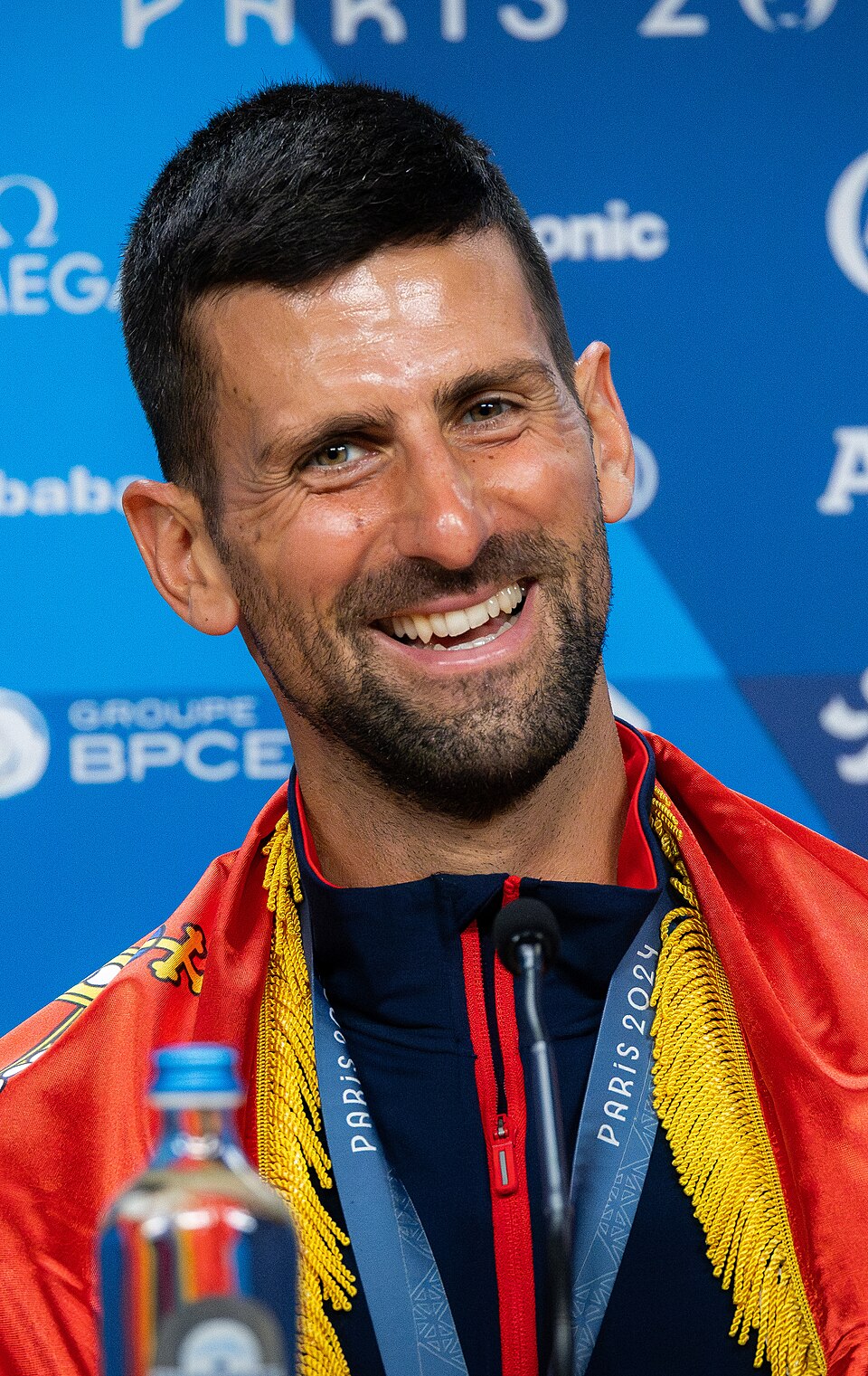
Novak Djokovic
Pete Sampras
Stat by stat
Bars are scaled to the leader in this list.
The verdict
Novak Djokovic leads 2 of 2 categories. Our all-time ranking places Novak Djokovic at #1 and Pete Sampras at #11.
Head-to-head FAQ
Who leads more shared metrics?
How do the published ranks compare?
Are these live stats?
The case for Novak Djokovic
Every major record that can be counted now points the same way. Djokovic's 24 Grand Slam singles titles are the most ever, tied with Margaret Court and achieved entirely against open, global, 128-draw fields. His 428 weeks at No.1 are over 50 more than anyone in history; his eight year-end No.1 finishes are unmatched; his 40 Masters 1000 titles are 4 clear of Nadal; and he is the only man to win every Slam, every Masters event and the ATP Finals — most of them multiple times, including a record 10 Australian Opens. The rivalry ledger is decisive: winning career head-to-heads against both Federer (27-23) and Nadal (31-29), the two other greatest players of his own era, at their peaks. His 2024 Paris Olympic gold at age 37, beating Alcaraz in the final, completed the career Golden Slam and removed the last box left unticked. He built the record on the era's hardest task — beating prime Federer and prime Nadal — and the numbers now stand alone.
The case for Pete Sampras
Sampras retired with what was then the men's all-time record of 14 majors, and the record most likely to survive the Big Three era is still his: six consecutive year-end No.1 finishes, 1993 through 1998, a run of sustained supremacy no man has matched before or since. His seven Wimbledon titles in eight years (1993-2000) were built on the most complete serving game the sport had seen — not the fastest serve, but the best-disguised, backed by a second serve routinely rated the greatest ever and an attacking all-court game that made him nearly unbreakable on fast surfaces. He spent 286 weeks at No.1, won 64 titles, and ended his career with a perfect exit: winning the 2002 US Open, beating Agassi in the final, and never playing another match. The gap in his record — no Roland Garros, with just one semifinal there — is why he sits near the bottom of this list rather than the middle; on everything but clay, he was the standard his successors chased.