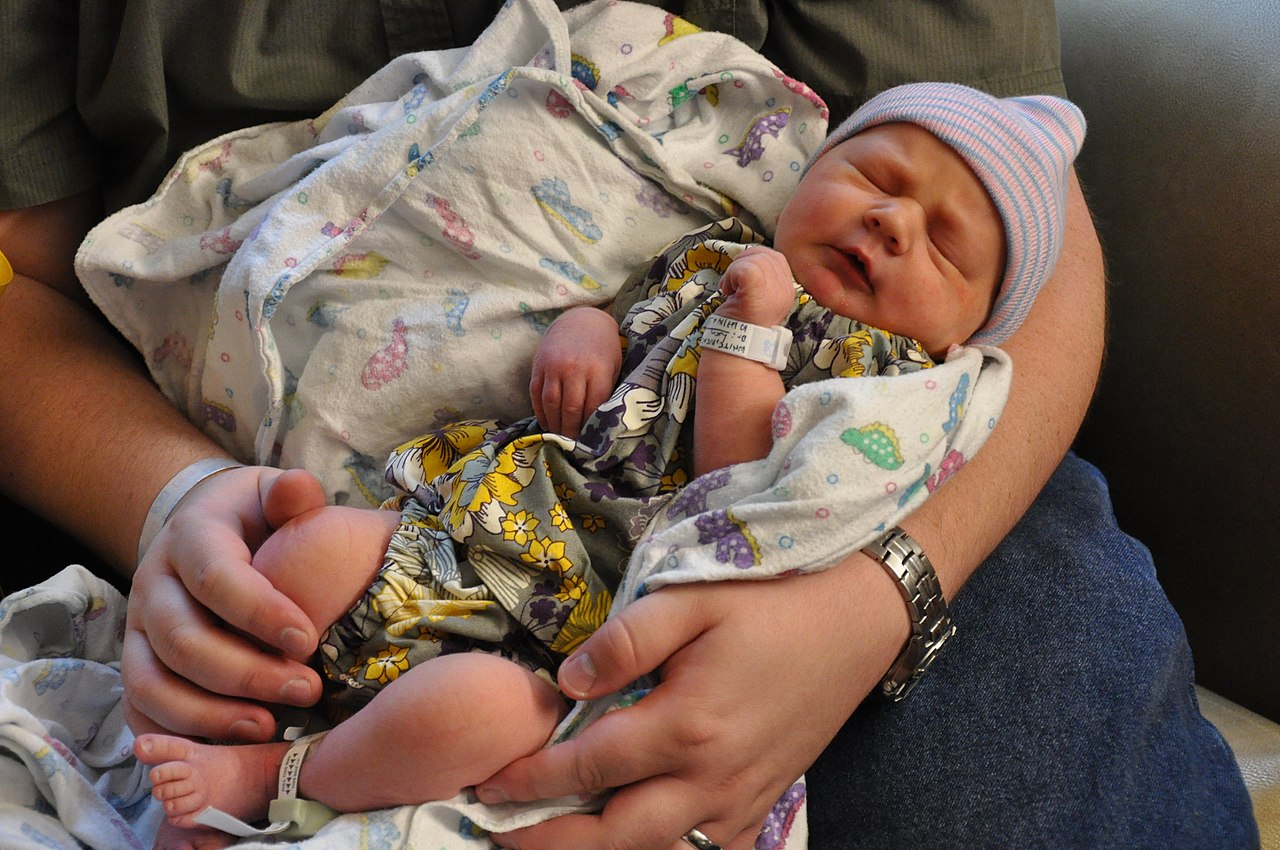
Skin-to-skin: after birth, once baby is medically stable, hold chest-to-chest before a long nursery separation. The same hold at home is how you notice rooting and temperature wobble. A wrap or robe keeps both of you warm so the hold lasts longer than a photograph.
How do I know feeding is working by day 5?
Offer breast or bottle when baby roots or at least every 2–3 hours. By day 5 the published count is six or more wet nappies in 24 hours — that count is the event, not a clock. Evening cluster feeds in the first week are a growth-spurt event, not proof the milk ran out.
What is the safe-sleep setup for every sleep?
Every sleep — first nap at home and 3 a.m. — is the same event: firm flat surface, on the back, no soft bedding, smoke-free room. Room-share in the same room; do not share the sleep surface, per AAP.
When is the first pediatric visit on the published checklist?
Schedule the first visit within 3–5 days. That visit, with the two-week weigh-in, is how the page confirms birth weight is coming back. Slow gain means more feeds, not longer stretches — do not skip a feed to “stretch” night sleep before weight is back.
Does holding or feeding on cue spoil a newborn?
No. This page treats responsive comfort and cue feeding as the practice, not a habit to break. Infants cannot manipulate or form a habit of being held at this age. The shame frame is not on the checklist; the listed items are visit, safe sleep, feeding plan, car seat, hand hygiene, postpartum support, thermometer, and emergency numbers.
Tonight's newborn sequence from published practice
A gentle order using practice steps already on this newborn hub — not a grade on your parenting.
Skin-to-skin first — Start with Skin-to-skin when baby is stable, as the page lists it.
Wet-nappy signal — Use Feed on cue as the intake cue the page names — not a clock or shame test.
Safe sleep every sleep — Repeat Safe sleep setup for naps and night feeds alike.
Event-pin is a reminder — Pinning an event marks what to revisit tonight, not how well you performed.
Sequence is support for tonight, not a report card.
Fever under three months, poor feeding, or distress still means call — not wait for the list.
Tonight's second practice sequence
A second gentle order from the next published practice labels on this newborn hub — still not a grade on parenting.
Weight check as a check-in — Use Weight check as a published check-in, not a pass/fail on parents.
Day-night cues softly — Try Day-night cues when energy allows — a cue, not a schedule exam.
Name the support network — Keep Support network visible so tonight is shared work, not solitary perfection.
Pin is still a reminder — Event pins mark what to revisit, not how well you scored.
A second sequence is more support for tonight, not a harder test.
Fever under three months, poor feeding, or distress still means call — not wait for the list.
One step tonight
No score and no shame. Not medical advice.
Quick facts
0–28 days post-birthWindow
14–17 hrs/day typicalSleep
8–12 feeds/24 hrsFeeding
Regain by ~2 weeksWeight
Exclusive breast ~6 moWHO cue
Pediatric check at 3–5 daysVisit
The newborn period spans roughly the first four weeks after birth — a time of rapid physiological adaptation, establishing feeding, and early attachment.
Research from Bowlby and Ainsworth onward treats these weeks as foundational for stress regulation and caregiver synchrony, though individual trajectories vary widely.
Global guidance from WHO and national pediatric societies emphasises skin-to-skin contact, safe sleep, and responsive feeding rather than rigid schedules.
The profile
Evidence strength88
Daily impact98
Difficulty85
Age span8
Expert consensus82
Urgency95
Age range
0–28 days
The first 28 days after birth — physiology, bonding, feeding rhythms, and the shift from womb to world.
The newborn period spans roughly the first four weeks after birth — a time of rapid physiological adaptation, establishing feeding, and early attachment.
How do I start with Newborn?
Skin-to-skin — After birth, once baby is medically stable, hold chest-to-chest before the first long nursery separation; the same hold at home is how you notice rooting and temperature wobble. — A wrap or robe keeps both of you warm so the hold lasts longer than a photograph.
What is the next practice step for Newborn?
Feed on cue — Offer breast or bottle when baby roots or at least every 2–3 hours; by day 5 count six or more wet nappies in 24 hours — that count is the event, not a clock. — Evening cluster feeds in the first week are a growth-spurt event, not proof the milk ran out.
What does research say about Newborn?
Early bonds matter — Maternal deprivation reports linked prolonged early separation to later emotional and social difficulties in institutionalised children.
Myth check: Umbilical cord bath delay
Brief immersion is fine once cord is kept dry — total sponge-only for weeks is unnecessary in most cases.
Which ages does Newborn matter most for?
Newborn is most relevant for 0–28 days.
How does Newborn look around the world?
Scandinavia — Extended leave — Generous paid parental leave lets one parent stay home full-time through much of the first year.
When does the newborn period end?
Most clinicians use 28 days; some extend to six weeks when colic and feeding patterns stabilise.
Also worth reading
Cross-category companions chosen for this topic — not more of the same shelf.