Milestones in order. This is history, not a weekly activity grid.
- The Knickerbocker Rules
- Nine innings, 90 feet
- First professional team
- National League founded
- First modern World Series
- The Black Sox scandal
- Ruth to New York; the Negro National League
- The Hall of Fame's first class
- Jackie Robinson breaks the color line
- The mound comes down
- Aaron passes Ruth
- Free agency arrives
- The strike cancels the World Series
- The curse ends in Boston
Last reviewed Sources & creditsMedia creditsMethodology
Quick answers
Who actually invented baseball?
No one person did, and specifically not Abner Doubleday — the Cooperstown creation story was manufactured by the 1907 Mills Commission on flimsy testimony, and Doubleday, a West Point cadet in 1839, never mentioned baseball in his writings. The game evolved from English bat-and-ball sports like rounders through American variants such as town ball; a 1791 bylaw in Pittsfield, Massachusetts already banned 'base ball' near the town meeting house. The decisive codification came from the Knickerbocker Base Ball Club of New York, whose 1845 rules — foul territory, three-out innings, tagging runners rather than throwing the ball at them — are the recognizable ancestor of the modern game. Alexander Cartwright, a Knickerbocker member, is the conventional individual credit, though historians now view even his role as shared with clubmates.
Why is a baseball game nine innings?
The 1845 Knickerbocker Rules had no fixed length — games ended when one side scored 21 'aces' (runs), usually taking about six innings. As pitching improved and scoring dropped, games dragged unpredictably, so an 1857 convention of sixteen New York clubs standardized the format: nine players per side and nine innings per game, with extra innings breaking ties. The choice of nine appears to have followed the roster size — nine positions, nine innings — rather than any deeper logic. The framework has proven nearly untouchable ever since: the only structural modifications in 165-plus years are the 2020 introduction of the extra-innings automatic runner on second base and the use of seven-inning games in doubleheaders during the 2020-21 pandemic seasons, the latter since abandoned at the major league level.
Why is hitting a baseball considered the hardest skill in sports?
The physics leaves almost no margin. A 95 mph fastball covers the 60 feet 6 inches from release to plate in roughly 0.4 seconds; accounting for the time a swing takes, the hitter must decide to commit when the ball is about halfway home, effectively predicting its final location. A few milliseconds of timing error or a quarter inch of contact error turns a home run into a pop-up, and modern pitchers layer 3,000-rpm breaking balls that tunnel with the fastball before diverging. The outcome data makes the case: the best hitters alive fail about 70 percent of the time, no one has batted .400 over a season since Ted Williams's .406 in 1941, and the league as a whole hit around .243 in 2024 against average fastballs of 94 mph.
What is the difference between the American League and National League?
Structurally, almost nothing anymore. The National League (founded 1876) and American League (major status from 1901) operated as legally separate leagues with their own presidents and umpires until MLB centralized in 2000, and interleague play only began in 1997. The famous on-field difference — the AL's designated hitter batting for the pitcher, adopted in 1973, while NL pitchers still hit — ended when the 2022 collective bargaining agreement made the DH universal. Today the leagues function as conferences: 15 teams each across three divisions, meeting in the All-Star Game and World Series. The identities persist culturally (the AL's historically offense-first reputation, old rivalries), and league affiliation still determines playoff bracketing, but a fan watching two games today will find no difference in rules between them.
What is WAR and why do analysts rely on it?
Wins Above Replacement estimates how many wins a player adds compared with a freely available minor league fill-in at the same position. It converts everything a player does — hitting, baserunning, fielding, position difficulty, and for pitchers, run prevention — into runs, then into wins, using the well-established relationship of about ten runs per win. Its power is comparability: WAR can weigh a slugging first baseman against a defense-first shortstop, or a 1920s outfielder against a modern one, because each is measured against his own league's baseline. Rules of thumb: 2 WAR is a solid starter, 5 is All-Star level, 8-plus is an MVP season, and career totals above 60 fuel Hall of Fame cases. Versions differ — Baseball-Reference and FanGraphs calculate pitching and defense differently — so serious analysis cites which WAR it means.
How many perfect games have there been in MLB history?
Twenty-four in over 240,000 major league games — a pitcher facing exactly 27 batters and retiring every one, allowing no hit, walk, hit batter, or error. The most recent was Domingo Germán of the Yankees on June 28, 2023, an 11-0 win at Oakland, ending a drought since 2012, which had been an anomalous boom year with three. The most famous remains Don Larsen's in Game 5 of the 1956 World Series, still the only postseason perfect game. The near-misses are their own genre: Armando Galarraga lost one in 2010 to an admitted umpire error on the 27th out, and Harvey Haddix threw 12 perfect innings in 1959 only to lose the game in the 13th. Rising strikeout rates should make perfection more attainable, yet five-and-dive starter usage means fewer pitchers are even allowed to try for 27 outs.
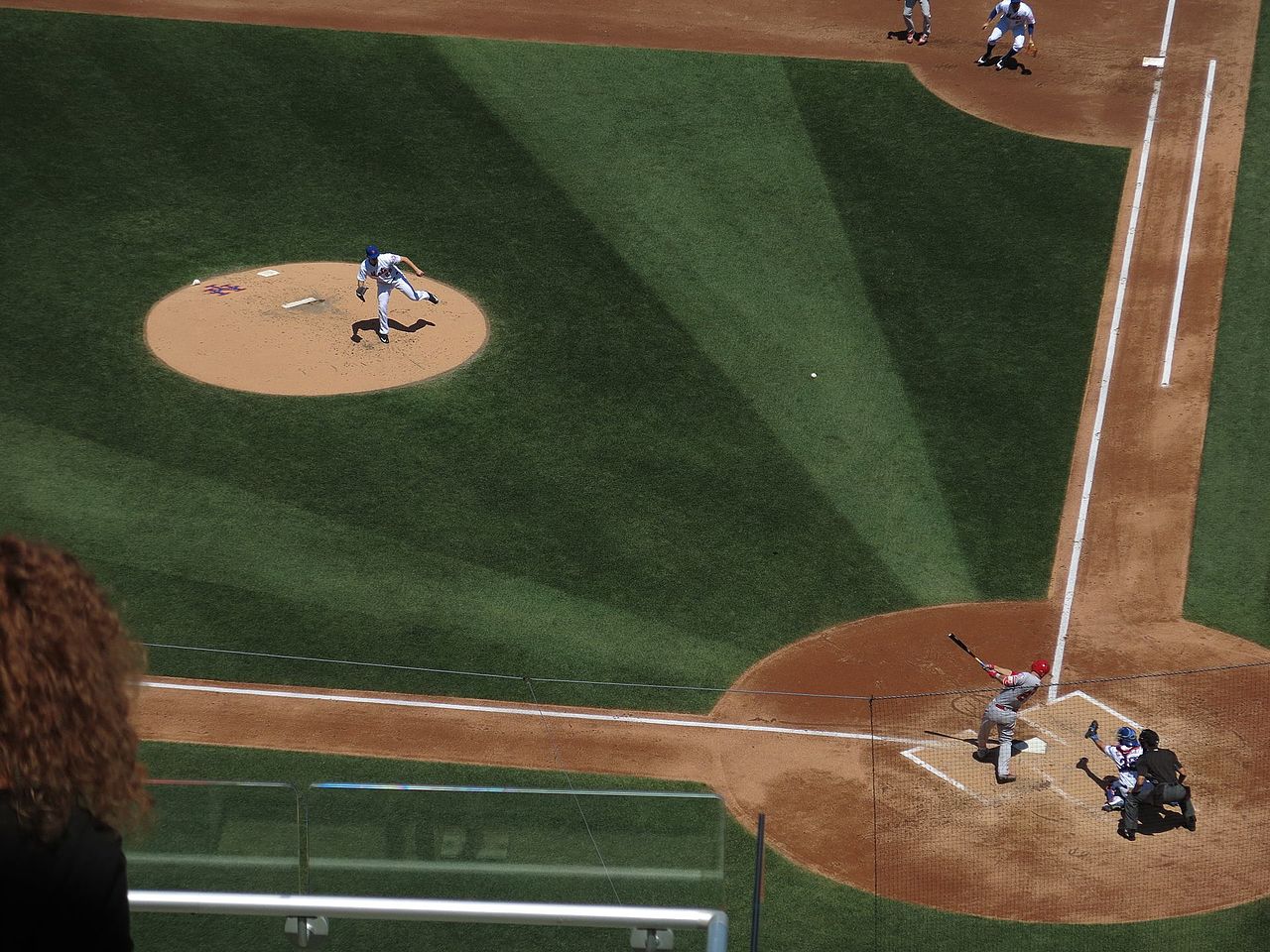
Baseball's creation myth — Abner Doubleday inventing the game in Cooperstown in 1839 — was manufactured by the 1907 Mills Commission and has been thoroughly debunked; Doubleday was a West Point cadet that year and never claimed any connection to the sport. The real story is evolutionary: English bat-and-ball games like rounders crossed the Atlantic, mutated into regional variants such as town ball and the Massachusetts game, and were finally codified by the Knickerbocker Base Ball Club of New York in 1845. A Pittsfield, Massachusetts bylaw from 1791 banning 'base ball' near a new meeting house proves the name is older than the republic's constitution-era buildings it threatened.
What followed is one of the richest institutional histories in sport: the first openly professional team in 1869, the oldest continuously operating professional league in American sport founded in 1876, a fixed World Series in 1919, a parallel Black baseball universe forced into existence by segregation, and a labor war that produced both free agency in 1975 and a canceled championship in 1994. The through line is a game whose field dimensions have barely changed since the 1850s while everything around them — economics, demographics, analytics, and now the rulebook's relationship with time itself — has been rebuilt repeatedly.
Timeline
Alexander Cartwright's Knickerbocker Base Ball Club of New York codifies 20 rules — foul territory, three-out innings, tagging instead of throwing the ball at runners — separating baseball from rounders and town ball.
A convention of sixteen New York clubs standardizes nine players, nine innings, and 90 feet between bases, replacing the old first-to-21-runs format. The geometry has never changed.
The Cincinnati Red Stockings become openly professional and barnstorm the country undefeated, going 57-0 and proving paid baseball can draw crowds.
William Hulbert launches the National League on February 2, 1876 — still operating today as the oldest continuous professional sports league in the United States.
The upstart American League's Boston Americans beat Pittsburgh five games to three in a best-of-nine, with Cy Young winning twice, cementing peace between the rival leagues.
Eight Chicago White Sox players, including Shoeless Joe Jackson, conspire with gamblers to throw the World Series against Cincinnati. Commissioner Kenesaw Mountain Landis bans all eight for life in 1921.
The Red Sox sell Babe Ruth to the Yankees, and he hits an unthinkable 54 home runs as the live-ball era ignites. That same year, Rube Foster founds the Negro National League in Kansas City.
Cooperstown elects its inaugural five: Ty Cobb (98.2 percent of the vote), Babe Ruth, Honus Wagner, Christy Mathewson, and Walter Johnson.
Robinson debuts for the Brooklyn Dodgers on April 15, 1947, ending six decades of segregation, and wins the inaugural Rookie of the Year award while enduring relentless abuse.
After 1968's 'Year of the Pitcher' — Bob Gibson's 1.12 ERA, Carl Yastrzemski winning a batting title at .301 — MLB lowers the mound from 15 to 10 inches and shrinks the strike zone.
Hank Aaron hits home run number 715 off Al Downing in Atlanta on April 8, 1974, breaking Ruth's record while carrying a burden of racist hate mail and death threats.
Arbitrator Peter Seitz voids the perpetual reserve clause in the Messersmith-McNally grievance on December 23, 1975. Player salaries rise roughly tenfold within a decade.
A players' strike beginning August 12 wipes out the postseason — the first World Series cancellation since 1904 — and the sport needs years, and the 1998 home run chase, to recover public goodwill.
The Red Sox become the only team in MLB postseason history to overturn a 3-0 series deficit, stunning the Yankees in the ALCS, then sweep St. Louis for their first title since 1918.
Camera-and-radar tracking is installed in all 30 parks. Exit velocity, launch angle, and spin rate enter the sport's everyday vocabulary and reshape player development.
Chicago wins Game 7 in Cleveland 8-7 in ten innings, after a rain delay and a blown 6-3 lead, claiming its first championship since 1908 — the longest drought in North American sports.
The pitch clock cuts average game time by 24 minutes, the extreme shift is banned, and bases grow to 18 inches. In March, Shohei Ohtani strikes out Mike Trout to clinch Japan's 3-2 World Baseball Classic final win over the USA.
Ohtani becomes the first player ever with 50 homers and 50 steals in a season (54/59), MLB incorporates Negro Leagues statistics into its official records — making Josh Gibson the career batting average leader at .372 — and the Dodgers beat the Yankees in the World Series.
The eras
From gentlemen's clubs to a professional industry
The Knickerbockers played baseball as a genteel exercise club; within two decades the Civil War had spread the New York rules through army camps and turned the game into a national commercial enterprise. The Cincinnati Red Stockings' undefeated 1869 tour demonstrated that openly paying players worked, and the National Association of 1871 — chaotic, gambler-ridden, and short-lived — gave way to William Hulbert's tightly controlled National League in 1876. The era settled most of the rulebook by trial and error: overhand pitching was legalized in 1884, four balls became a walk in 1889, and the pitching distance moved back to 60 feet 6 inches in 1893, instantly inflating batting averages. It was also the era of original sin. The 1880s saw Black players like Moses Fleetwood Walker in the majors, but by the 1890s an unwritten agreement had drawn the color line that would hold for half a century. By 1900 the professional game had monopoly economics, a reserve clause binding players to clubs for life, and a settled 154-game structure awaiting only a rival league to complete the modern map.
The dead-ball era
Ban Johnson's American League declared major status in 1901, raided National League rosters, and forced the 1903 peace that created the World Series. On the field, this was baseball as attrition: a single ball was kept in play until it was a scuffed, tobacco-stained lump, spitballs were legal, and runs were manufactured with bunts, steals, and the hit-and-run. Home run champions won titles with totals like nine. The era's giants were pitchers and slashers — Walter Johnson's sidearm fastball, Christy Mathewson's three shutouts in the 1905 World Series, Ty Cobb hitting .420 in 1911 and stealing 96 bases in 1915. Attendance boomed, concrete-and-steel cathedrals like Fenway Park (1912) and Wrigley Field (1914) replaced wooden firetraps, and the Federal League's 1914-15 challenge briefly cracked the monopoly. It ended in disgrace: the 1919 Black Sox fix, exposed in 1920, threatened the sport's legitimacy so profoundly that owners handed a federal judge, Kenesaw Mountain Landis, near-absolute power as the first commissioner.
The live-ball era and the parallel game
Babe Ruth did not just break records in 1920; he broke the sport's aesthetic. His 54 home runs that season exceeded the total of every other American League team, and the game reorganized itself around slugging almost overnight — trick pitches were banned, clean balls rotated into play, and scoring surged. The Yankees built the first superteam dynasty, winning their first title in 1923 and adding Murderers' Row in 1927, when Ruth hit 60. Radio broadcasts, the first All-Star Game in 1933, and night baseball at Crosley Field in 1935 industrialized the fan experience. In parallel, segregation forced the creation of a complete alternative baseball universe: Rube Foster's Negro National League and its successors produced Josh Gibson, Satchel Paige, Oscar Charleston, and Cool Papa Bell — players of undisputed major league quality barnstorming against, and often beating, white all-star teams. World War II drained rosters, sent Ted Williams and Bob Feller to war, and spawned the All-American Girls Professional Baseball League. The contradiction of Black soldiers returning from that war to a segregated national pastime became untenable.
Integration and the continental game
Branch Rickey's signing of Jackie Robinson was both a moral watershed and a talent arbitrage: within a decade, the NL's best players were disproportionately Black and Latino — Willie Mays, Hank Aaron, Ernie Banks, Frank Robinson, Roberto Clemente — and the National League won exclusive bragging rights in the All-Star Game for a generation. The Dodgers and Giants moved to California in 1958, dragging the sport across the continent, and expansion in 1961-62 grew the majors from 16 teams to 20 while stretching the season to 162 games. Roger Maris hit 61 home runs in 1961 under an asterisk controversy that said everything about the sport's reverence for its own numbers. The era closed with pitching ascendant to the point of crisis: in 1968 Bob Gibson posted a 1.12 ERA, Denny McLain won 31 games, and the entire American League hit .230. The mound was lowered and the strike zone tightened for 1969 — the first time baseball explicitly engineered its rules to rebalance offense, a habit it would rediscover in 2023.
Free agency and the players' game
Curt Flood's 1970 refusal to accept a trade — 'I do not regard myself as a piece of property' — lost in the Supreme Court but lit the fuse. Marvin Miller's players union won salary arbitration in 1973, and in December 1975 arbitrator Peter Seitz freed Andy Messersmith and Dave McNally, killing the perpetual reserve clause. The average salary rose from about 45,000 dollars in 1975 to over a million by 1992, through strikes in 1972, 1981, and 1985 and an owners' collusion scandal in the mid-1980s that cost them 280 million dollars in damages. On the field the era was gloriously plural: the Big Red Machine and Carlton Fisk's Game 6 homer in the epic 1975 World Series, Oakland's mustachioed threepeat, Rickey Henderson stealing 130 bases in 1982, and Whiteyball speed on artificial turf coexisting with bash-brother power. The designated hitter arrived in the American League in 1973, splitting the sport's tactical identity in two for the next half century.
The steroid shadow and the analytics revolution
The 1994-95 strike canceled a World Series and alienated a generation; the 1998 McGwire-Sosa home run chase won them back at a price the sport is still paying. Barry Bonds hit 73 in 2001, the 2007 Mitchell Report named names, and Hall of Fame ballots became morality referenda. Meanwhile a quieter revolution mattered more: Billy Beane's 2002 Athletics won 103 games and an AL-record 20 straight on a bottom-five payroll by buying on-base percentage the market undervalued, and Michael Lewis's Moneyball (2003) turned front offices into quant shops. Statcast (2015) measured everything; the 2017 Astros showed analytics' dark side with a trash-can sign-stealing scheme. Strikeouts eclipsed hits league-wide for the first time in 2018, and MLB answered the aesthetic crisis with 2023's pitch clock, shift restrictions, and bigger bases — the boldest rule package in a century. The Ohtani era now anchors a genuinely global game: record revenues around 12 billion dollars, record NPB attendance, and Los Angeles winning back-to-back titles in 2024 and 2025 with a roster built in three countries.
Baseball's history is best read as a long negotiation between preservation and repair. The sport that refuses to alter 90 feet between bases has repeatedly rebuilt everything else — its labor economics in 1975, its racial composition in 1947, its record book in 2024 when Negro Leagues statistics finally entered the official ledger, and its very tempo in 2023. Each intervention was resisted as heresy and absorbed within a season. That pattern, more than any single milestone, explains how a game codified by Manhattan clerks in 1845 still fills 70 million seats a year.
Keep exploring
More in this category
Soccer
The simplest game on Earth, played by hundreds of millions and argued over by half the planet.
🏀Basketball
Five players, 24 seconds, and geometry at full sprint — the city game that conquered the world.
🏈Football
Four downs, ten yards, one end zone: the ultimate game of territory, collision, and coaching.
🏏Cricket
The bat-and-ball contest where a single match can last five days and still turn on one ball.
🏉Rugby Union
Fifteen players, eighty minutes of collision and continuity, and a code that prizes the contest for the ball above all else.
🏒Hockey
The fastest team sport on Earth: six skaters, one frozen puck, and no time to breathe.
🏐Volleyball
Three touches, no second chances: the fast, vertical duel fought across a net no one may cross.
🤾Handball
The fastest scoring team sport on the planet: seven a side, thirty minutes a half, and a goal roughly every ninety seconds.