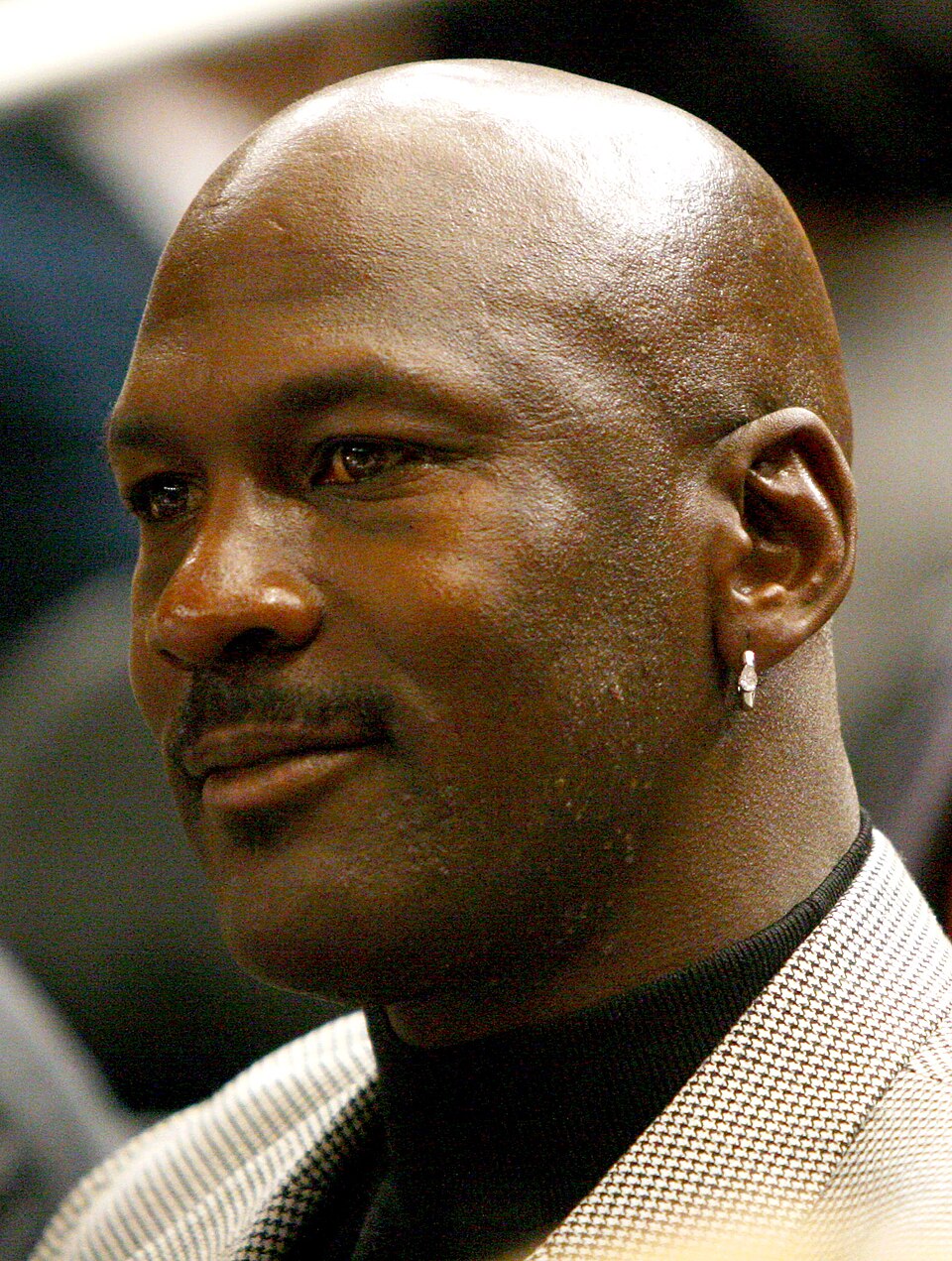
Michael Jordan
Stephen Curry
Stat by stat
Bars are scaled to the leader in this list.
The verdict
Michael Jordan leads 3 of 3 categories. Our all-time ranking places Michael Jordan at #1 and Stephen Curry at #11.
Head-to-head FAQ
Who leads more shared metrics?
How do the published ranks compare?
Are these live stats?
The case for Michael Jordan
The most complete resume at the highest peak. Jordan won six championships in six Finals appearances, took Finals MVP all six times, and never allowed a series to reach a Game 7. He won five regular-season MVPs, ten scoring titles — both records for a perimeter player — and retired with the highest career scoring average in NBA history at 30.1 points per game. The two-way case seals it: 1988 Defensive Player of the Year, nine All-Defensive First Team selections, and 2,514 career steals, third all-time. His 1990–91 through 1992–93 and 1995–96 through 1997–98 three-peats bracket a 6–0 decade in which his teams beat Hall of Fame opposition — Magic's Lakers, Barkley's Suns, Malone and Stockton's Jazz twice — and his 33.4 points per game across 179 playoff games remains the highest postseason average ever. The 72–10 season of 1995–96 and the 1998 title-winning shot in Utah are the era's defining monuments. No player has combined scoring supremacy, defensive excellence and flawless Finals results at his level.
The case for Stephen Curry
The most influential player of the modern era and the man who repriced the sport. Curry has won four championships with Golden State (2015, 2017, 2018, 2022), two regular-season MVPs — including the first unanimous MVP in league history in 2016 — and the 2022 Finals MVP that answered the last question about his resume. He is the greatest shooter who has ever lived by a wide margin: the all-time leader in three-pointers made, past 4,000 and climbing, having broken Ray Allen's career record in December 2021 with hundreds of games in hand. His 2015–16 season paired 30.1 points per game with a then-record 402 threes and powered a 73–9 team that broke the 1996 Bulls' win record. The deeper case is systemic — his off-ball movement and 30-foot range force defenses to guard the entire halfcourt, warping coverages without the ball and accelerating the three-point revolution more than any player since the shot clock. Rankings that omitted him a decade ago now routinely seat him among the ten greatest ever.