At a glance
Battle of Britain · taglineThe 1940 air campaign in which the RAF denied Germany daylight control of…
Battle of Britain · Fighter Command under Dowding, with Park's 11 Group in the southFighter Command under Dowding, with Park's 11 Group in the southeast, used…
Battle of Britain · Churchill's "Few" sentence made this the British civic air warChurchill's "Few" sentence made this the British civic air war.…
Battle of Britain · paras 1June 1940 left Britain expecting invasion. The Channel was a moat only if the…
Fighter Command under Dowding, with Park's 11 Group in the southeast, used Chain Home radar and a ground-controlled interception system that was as important as any Spitfire silhouette. RAF aircrew dead in the battle period are usually counted in the high hundreds; Luftwaffe aircrew losses were higher. Civilian deaths belong mainly to the Blitz ledger that overlapped and outlasted the official battle.
Battle of Britain · tagline
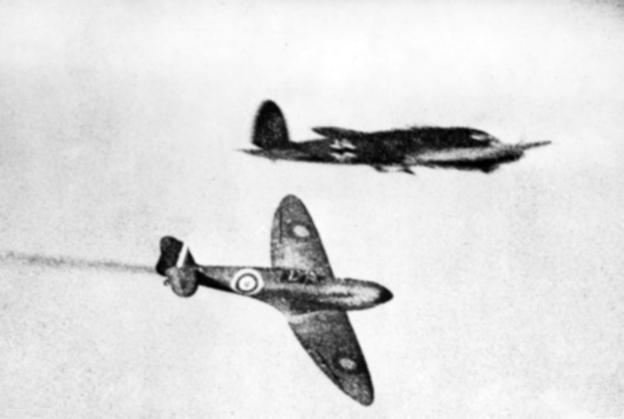
The 1940 air campaign in which the RAF denied Germany daylight control of southern England -- a prerequisite for any invasion scare, and a British memory engine. The Battle of Britain, in RAF official dating, ran from 10 July to 31 October 1940: Kanalkampf over the Channel, then attacks on airfields and aircraft plants, then the turn toward London after 7 September.
Battle of Britain · Fighter Command under Dowding, with Park's 11 Group in the south
Fighter Command under Dowding, with Park's 11 Group in the southeast, used Chain Home radar and a ground-controlled interception system that was as important as any Spitfire silhouette. RAF aircrew dead in the battle period are usually counted in the high hundreds; Luftwaffe aircrew losses were higher. Civilian deaths belong mainly to the Blitz ledger that overlapped and outlasted the official battle.
Battle of Britain · Churchill's "Few" sentence made this the British civic air war
Churchill's "Few" sentence made this the British civic air war. English-speaking memory sometimes treats it as the war; it was a necessary 1940 survival, not 1945. Korean readers should hear it beside the later UN air war in 1950-53: radar and fighters as a defensive system, not as a how-to of interception.
Battle of Britain · paras 1
June 1940 left Britain expecting invasion. The Channel was a moat only if the air above it was contested. Sea Lion was a sketch that needed a sky. August attacks on 11 Group fields (Biggin, Kenley, Hornchurch) were the dangerous week. Park's tactics -- meet them forward, do not empty the fields -- remain a historians' argument with Leigh-Mallory's Big Wing.
This explains a campaign, battle, or weapon in context. It is not a league of nations. It does not replace the full topic page.
Questions
- What is the next question after this?
- Churchill's "Few" sentence made this the British civic air war. English-speaking memory sometimes treats it as the war; it was a necessary 1940 survival, not 1945. Korean readers should hear it beside the later UN air war in 1950-53: radar and fighters as a defensive system, not as a how-to of interception.
- Does this page rank people or nations?
- This explains a campaign, battle, or weapon in context. It is not a league of nations. It does not replace the full topic page.
- Where is the longer entry?
- June 1940 left Britain expecting invasion. The Channel was a moat only if the air above it was contested. Sea Lion was a sketch that needed a sky. August attacks on 11 Group fields (Biggin, Kenley, Hornchurch) were the dangerous week. Park's tactics -- meet them forward, do not empty the fields -- remain a historians' argument with Leigh-Mallory's Big Wing.
Next question: Carnation Revolution · Open the topic: Battle of Britain
Why is "a single assassination headline" the wrong stop when reading the August mobilization in 1914? · Why is "a paper count of tanks" the wrong stop when reading the campaign in France in 1940? · Why is "the landing nickname alone" the wrong stop when reading the Inchon landing in 1950? · Why is "a body-count column" the wrong stop when reading the Tet offensive in 1968? · Why is "the battle nickname alone" the wrong stop when reading Austerlitz in 1805? · Why is "one casualty total" the wrong stop when reading Gettysburg in 1863? · 50 campaign reading notes