At a glance
Battle of Stalingrad · taglineThe 1942-43 Volga battle that destroyed the German 6th Army and turned the…
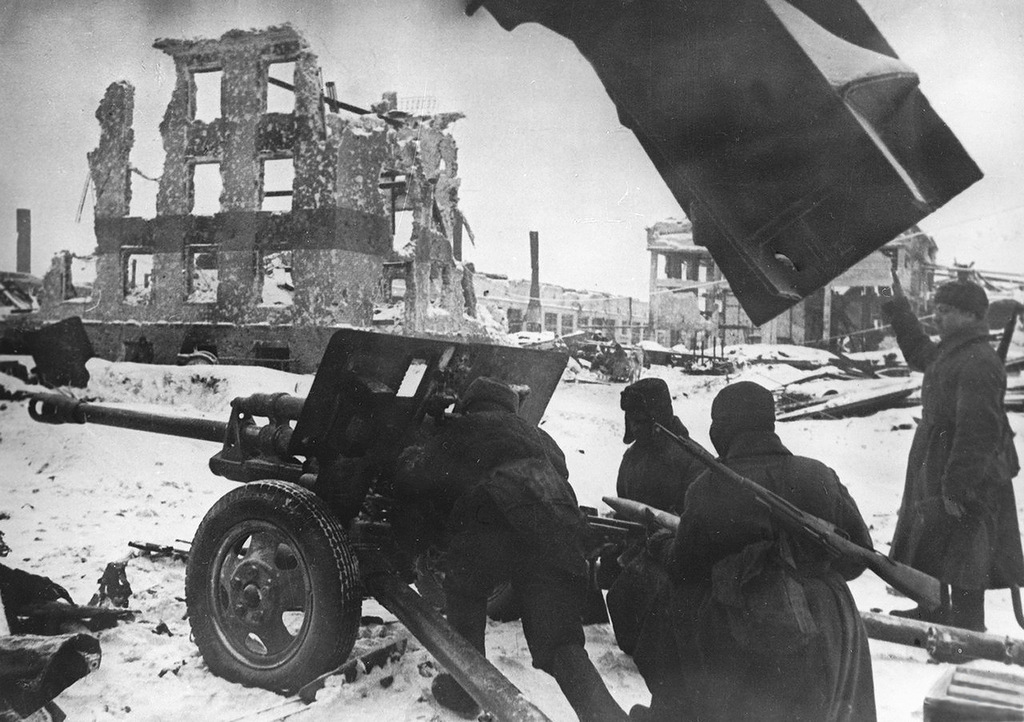
Battle of Stalingrad · Street fighting in the ruins, the factory district, and Mamayev Street fighting in the ruins, the factory district, and Mamayev Kurgan…
Battle of Stalingrad · Relief (Winter Storm) failedRelief (Winter Storm) failed. The airlift could not supply a pocket. The…
Battle of Stalingrad · paras 1Case Blue (1942) aimed at oil and the Caucasus. The city on the river was a…
Street fighting in the ruins, the factory district, and Mamayev Kurgan produced casualty totals in a band of about 1.7-2 million killed, wounded and captured on both sides -- among the costliest single battles ever recorded. The Soviet encirclement (Operation Uranus, 19 November 1942) trapped the 6th Army when the Romanian and Italian flanks collapsed.
Battle of Stalingrad · tagline
The 1942-43 Volga battle that destroyed the German 6th Army and turned the European war on the Eastern Front. The Battle of Stalingrad ran from the German 6th Army's approach and the 23 August 1942 air raid to Field Marshal Paulus's surrender on 2 February 1943. Hitler had made the city that bore Stalin's name a political object; Stalin forbade retreat with Order No. 227 ("Not one step back").
Battle of Stalingrad · Street fighting in the ruins, the factory district, and Mamayev
Street fighting in the ruins, the factory district, and Mamayev Kurgan produced casualty totals in a band of about 1.7-2 million killed, wounded and captured on both sides -- among the costliest single battles ever recorded. The Soviet encirclement (Operation Uranus, 19 November 1942) trapped the 6th Army when the Romanian and Italian flanks collapsed.
Battle of Stalingrad · Relief (Winter Storm) failed
Relief (Winter Storm) failed. The airlift could not supply a pocket. The surrender of a German field army on the Volga ended the myth of unbroken Wehrmacht success in the east and became the Soviet -- and later Russian -- patriotic hinge, taught in English as the Eastern Front's turning point beside Midway and El Alamein.
Battle of Stalingrad · paras 1
Case Blue (1942) aimed at oil and the Caucasus. The city on the river was a transport hinge and a name. Hitler and Stalin both refused to treat it as optional. The 19 November attack hit the weaker allied armies on the flanks, not the German urban spearhead. Within days the pocket closed.
This explains a campaign, battle, or weapon in context. It is not a league of nations. It does not replace the full topic page.
Questions
- What is the next question after this?
- Relief (Winter Storm) failed. The airlift could not supply a pocket. The surrender of a German field army on the Volga ended the myth of unbroken Wehrmacht success in the east and became the Soviet -- and later Russian -- patriotic hinge, taught in English as the Eastern Front's turning point beside Midway and El Alamein.
- Does this page rank people or nations?
- This explains a campaign, battle, or weapon in context. It is not a league of nations. It does not replace the full topic page.
- Where is the longer entry?
- Case Blue (1942) aimed at oil and the Caucasus. The city on the river was a transport hinge and a name. Hitler and Stalin both refused to treat it as optional. The 19 November attack hit the weaker allied armies on the flanks, not the German urban spearhead. Within days the pocket closed.
Next question: Submarine · Open the topic: Battle of Stalingrad
Why is "a single assassination headline" the wrong stop when reading the August mobilization in 1914? · Why is "a paper count of tanks" the wrong stop when reading the campaign in France in 1940? · Why is "the landing nickname alone" the wrong stop when reading the Inchon landing in 1950? · Why is "a body-count column" the wrong stop when reading the Tet offensive in 1968? · Why is "the battle nickname alone" the wrong stop when reading Austerlitz in 1805? · Why is "one casualty total" the wrong stop when reading Gettysburg in 1863? · 50 campaign reading notes