Darker cells mean a higher score for this topic on that metric.
LessMore
Last reviewed Sources & creditsMedia creditsMethodology
Quick answers
Why do bald eagles show a white head only as adults?
The white head and tail typically appear after four to five years. Juveniles are mottled brown, which reduced historical miscounts in winter surveys.
How fast is an eagle stoop compared with level flight?
Level cruising for large eagles is often 50–80 km/h. A hunting stoop is a different regime — trained golden eagles have been filmed above 240 km/h.
Did DDT almost erase North American bald eagles?
By 1963 the lower-48 count was about 417 nesting pairs. The 1972 DDT ban plus Endangered Species Act protection preceded the 2007 delisting.
Are “eagle” species one lineage?
No. “Eagle” is a grade inside Accipitridae. Sea eagles (Haliaeetus) and booted eagles (Aquila) split tens of millions of years ago.
Why is the Philippine eagle a different conservation story?
Pithecophaga jefferyi is a forest-interior endemic with perhaps a few hundred adults. Logging and shooting, not eggshell thinning, dominate the threat list.
Do eagles mate for life?
Many pairs are socially monogamous and reuse eyries, but extra-pair behaviour and mate replacement after nest failure are documented.
IUCN mix: LC→CR by species
Anatomy overlay
Numbered teaching hotspots on the species still — not a clinical diagnosis.
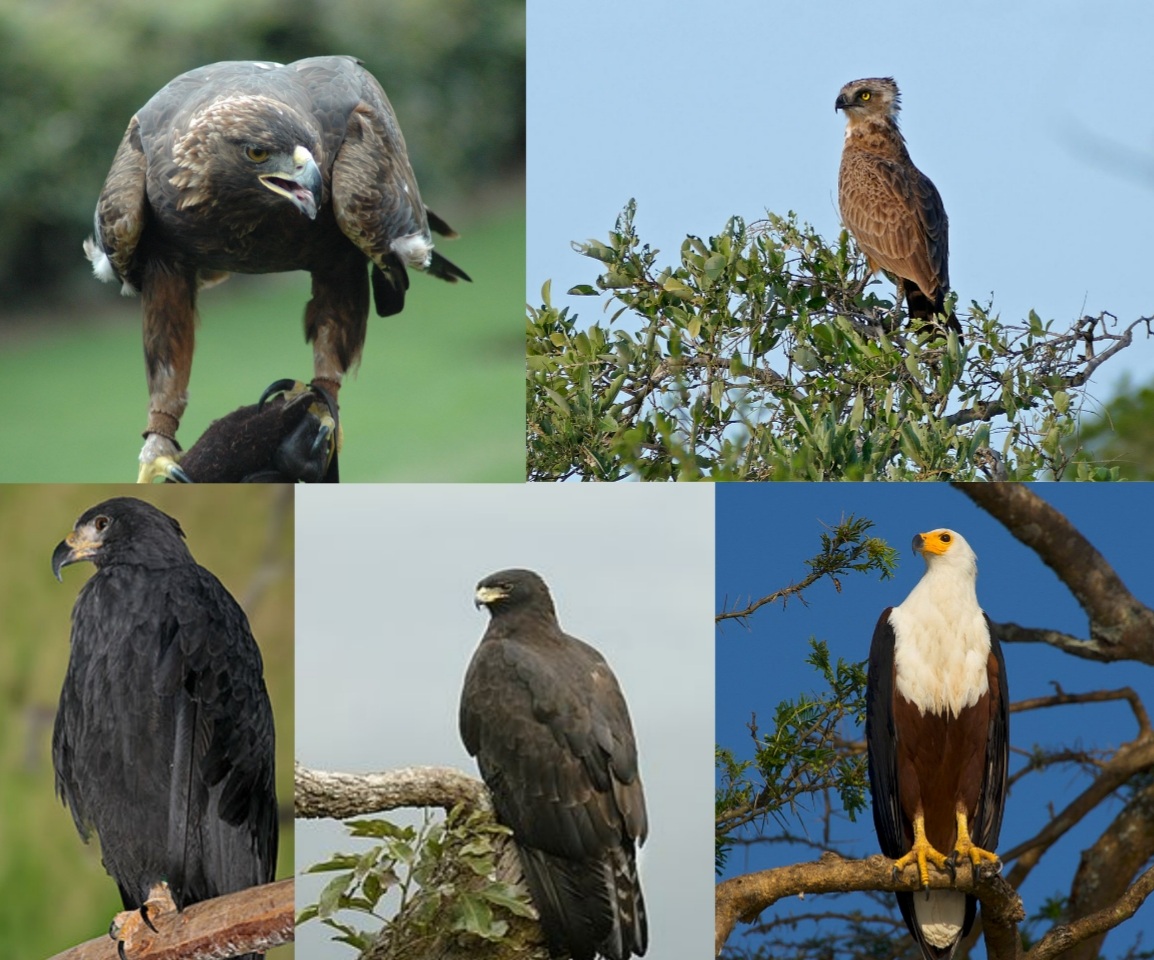
- 1 Primary weapon or tool — The bill, teeth, trunk, pouch or talon that field guides name first -- and that trade or c
- 2 Energy store — Fat, cache, crop or bamboo hours that decide whether a season closes.
- 3 Natal or breeding site — A redd, eyrie, den, anemone or ice lair -- often a single-point risk (Izumi, Natron, Gir).
- 4 Sensory organ — A fovea dense with cone cells supports high-acuity prey detection at distance. Oil droplet
- 5 Human interface — Hunt, tourism, film or quota -- the surface where eagle biology meets English-language law
Anatomy overlay
Four teaching regions on Eagle. A schematic, not a dissection guide.
Every eagle is a stack of tissues that must agree under season, prey and human pressure.
Meters below repeat the six atlas scores as gauges; they are relative marks, not laboratory certificates.
Systems
Support and integument
A fused carpometacarpus, large ungual talons and a hooked bill define the killing kit. Sea eagles add a heavier tarsus for fish; booted eagles add feathered tarsi for cold and mammal prey.
Feeding apparatus
Sit-and-wait on a commanding perch, then a short powered chase or a long stoop. Kleptoparasitism on ospreys saves hunt energy on salmon rivers. The feeding kit sets the ecological-role score relative to the other 23 types.
Respiration and circulation
Gas exchange and blood flow are tuned to the eagle energy budget -- dive, hover, sprint or bulk browse -- not to a generic vertebrate template.
Senses and neural control
A fovea dense with cone cells supports high-acuity prey detection at distance. Oil droplets and a pecten oculi are the usual avian optical extras.
Reproduction and ontogeny
Replacement rate is the hidden resilience number. Wing loading limits closed-canopy pursuit. Lead, rodenticides and turbine blades are modern ceilings that talons cannot solve.
Thermoregulation and salt/water
Climate and osmoregulation bound where a eagle can close its daily budget. Field sites in the English-speaking world still measure that envelope first.
Relative meters
Hotspots
Primary weapon or tool
The bill, teeth, trunk, pouch or talon that field guides name first -- and that trade or conflict usually targets.
Energy store
Fat, cache, crop or bamboo hours that decide whether a season closes.
Natal or breeding site
A redd, eyrie, den, anemone or ice lair -- often a single-point risk (Izumi, Natron, Gir).
Sensory organ
A fovea dense with cone cells supports high-acuity prey detection at distance. Oil droplets and a pecten oculi are the usual avian optical extras.
Human interface
Hunt, tourism, film or quota -- the surface where eagle biology meets English-language law.
Tissues & materials
Keratin and integument
Feathers, fur, baleen or skin plates -- tissues, not metals. Moult and wear are the maintenance cycle.
Bone and cartilage
Load paths for stoop, lunge, knuckle-walk or hover. Marrow and pneumatic bone differ by family.
Muscle and tendon
The expensive tissue that speed and intelligence scores only hint at.
Fat, oil and glycogen
Stores that migration, fast and lactation spend. A market for those stores (oil, ivory, fin) is a historical threat.
Keep exploring
More in Birds
Owl
Nocturnal raptors whose facial discs, silent flight and asymmetric ears turn darkness into a hunting map.
Overall 72 🐧Penguin
Flightless southern divers that turned wings into flippers and ice edges into commute routes.
Overall 56 🐦Hummingbird
New World nectar specialists that hover on figure-eight wings and migrate on a few grams of fat.
Overall 63 🦩Flamingo
Long-legged filter feeders whose bent bills and carotenoid diets turn alkaline lakes into pink cities.
Overall 52 🦜Parrot
Zygodactyl hookbills whose social brains, mimicry and nest-cavity needs collide with the cage trade.
Overall 58 🪽Albatross
Dynamic-soaring ocean birds whose metres-long wings and baited longlines now share the same latitudes.
Overall 58 🦢Crane
Tall wetland dancers whose red-crowned East Asian population is the atlas type and a conservation bottleneck.
Overall 53