Hummingbird is one of 24 types in this animals atlas. The pages treat it as a full system -- history, anatomy, operating principles, culture, icons, future pressure and market shape -- not a ranking of a best species.
Scores compare the hummingbird with the other 23 types on speed, intelligence, range, resilience, cultural impact and ecological role. They are relative editorial marks. Resilience high means more secure; low means threatened. Most continental species are Least Concern; island and cloud-forest endemics carry the Red List weight.
Seven chapters follow: origins, systems, how the animal works, cultural life, named icons, what conservation can still change, and how tourism, conflict, fisheries and parks move money.
Deep introduction
Deep dive: Hummingbird
Hummingbird is not a single postcard animal. It is a set of populations, subspecies and human rules inside the birds family of this atlas.
Diversity, bodies, culture and ranges — plus a lens tuned to this language region.
Diversity inside the type
Field guides collapse many lineages into the word hummingbird. Subspecies, flyways and captive lines do not share one fate.
This atlas picks a Wikipedia title as the hero image and then keeps the rest of the grade in view so a recovered stock cannot launder a Critically Endangered cousin.
Life in the landscape
A tiny fuselage, a long bill and a shoulder joint that lets the wing invert. Pectoralis and supracoracoideus are both huge for the upstroke’s lift.
Nectar sugars plus insect protein. Hovering is among the costliest vertebrate gaits; torpor is the nightly rebate.
Culture and meaning
Culture met the hummingbird through film, law, heraldry, zoos and local story. Those portrayals move money and sometimes take; they are not a field census.
The culture chapter dates posters and statutes so a 1975 film or a 1961 logo cannot pretend to be a 2020s Red List.
Conservation and money
Most continental species are Least Concern; island and cloud-forest endemics carry the Red List weight.
Tourism, conflict payments, quotas and captive loans are dated economic bands in the market chapter -- not live prices and not a best-species prize.
Life-science deep dive
Biology deep dive: Hummingbird
Hummingbird biology is a stack of structure, energy, sensing and hard limits. The four sections below are the same headings used across the atlas so types can be compared without a best-species frame.
Anatomy, senses, behaviour and limits — plus field language for this region.
Structure
A tiny fuselage, a long bill and a shoulder joint that lets the wing invert. Pectoralis and supracoracoideus are both huge for the upstroke’s lift.
Load paths and tissues (not metals) are expanded in the anatomy chapter.
Energy and foraging
Nectar sugars plus insect protein. Hovering is among the costliest vertebrate gaits; torpor is the nightly rebate.
The how-it-works diagrams reduce that budget to a six-node loop.
Senses and control
Colour vision into the near-ultraviolet helps flower finding. Spatial memory of traplines is the cognitive load.
Control here means the animal steering itself -- not a machine dashboard.
Limits
Gram-scale fat stores and weather windows bound migration. Island endemics have nowhere to shift when scrub is cleared.
Resilience scores encode those limits relative to the other 23 types.
Four other atlas types, six terms, three threads and three local notes -- a map out of the hummingbird page without leaving the 24-id taxonomy.
See-also species, key terms, adjacent threads and regional notes for this language.
See also
🦩FlamingoAnother bird whose diet paints the body — nectar vs brine shrimp.
🪽AlbatrossOpposite wing: hover specialist vs dynamic soarer.
🐴SeahorseAnother hovering feeder that looks delicate and is metabolically expensive.
🦜ParrotNeotropical canopy neighbour with a different social intelligence.
Key terms
Figure-eight stroke
Wing-tip path that makes lift on both down and upstroke — the hover trick.
Torpor
Night-time metabolic drop that keeps a 3 g bird from starving before dawn.
Gorget
Iridescent throat patch in many males — angle-dependent, not pigment-only.
Trapline
Repeated nectar circuit of scattered flowers, as opposed to a defended patch.
Bee hummingbird
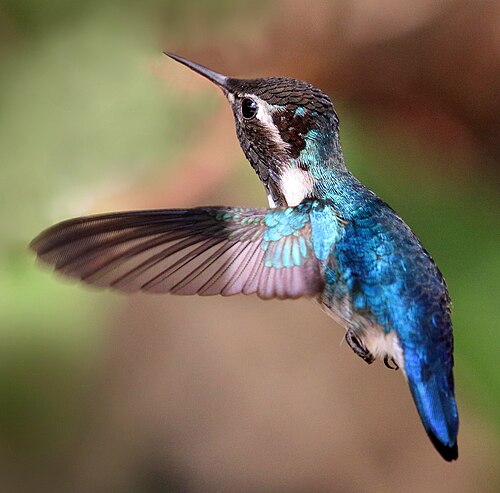
Mellisuga helenae — smallest living bird, Cuban endemic.
Gulf crossing
Ruby-throated nonstop flight over the Gulf of Mexico on spring and autumn migration.
Habitat and movement
Where the hummingbird breeds and feeds is the first constraint. Single lakes, islands and forests appear again in the history timeline.
Range scores in this atlas mark how widely that movement runs -- albatross and blue whale high, koi and panda low -- not a quality ranking.
Research and law
Named projects (Project Tiger, ACAP, ICCAT, Amboseli) are the conservation bureaucracy of the type.
Listings and downlists are dated events in the timeline, not eternal essences.
Culture and price
Film, auction and logo years are filed under culture and market so they cannot masquerade as demography.
The icons chapter keeps eight real Wikipedia titles so a later language pack can attach the same faces.
Visual field notes
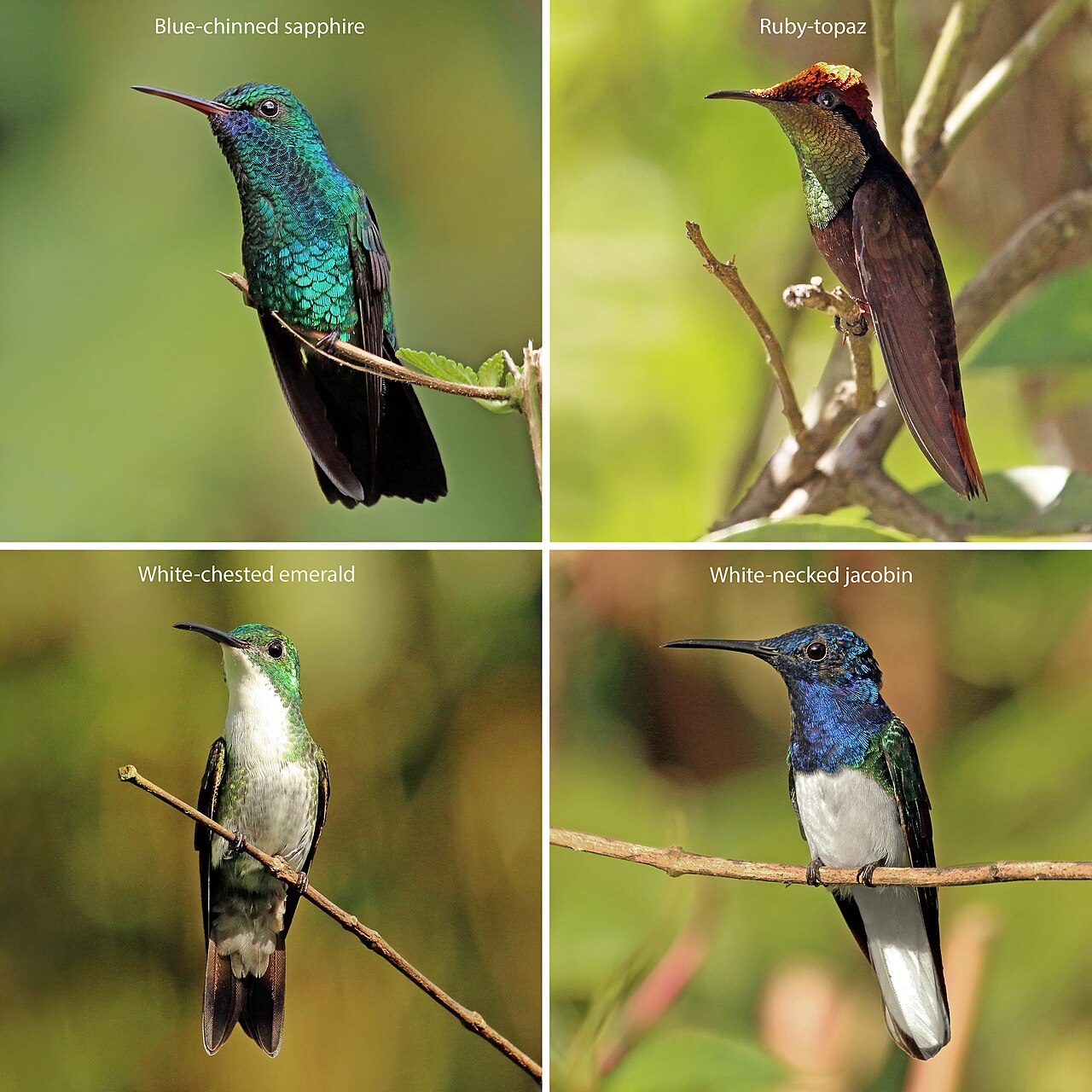
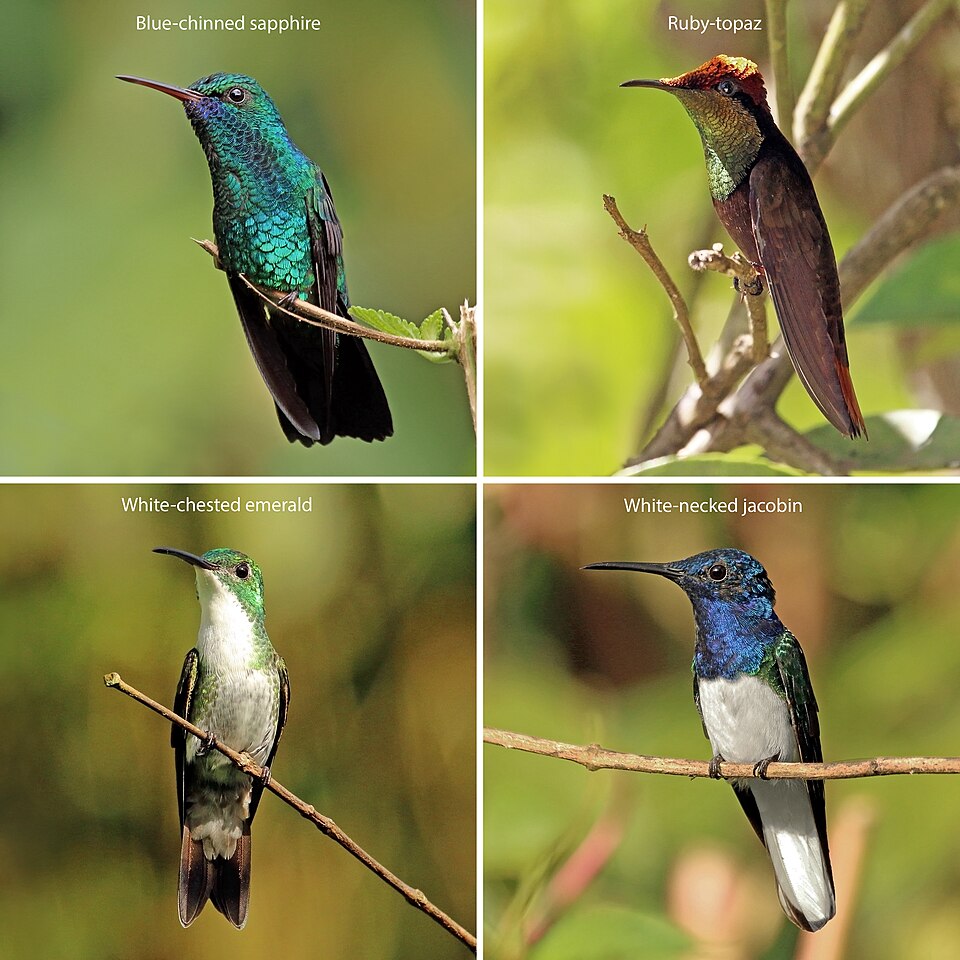
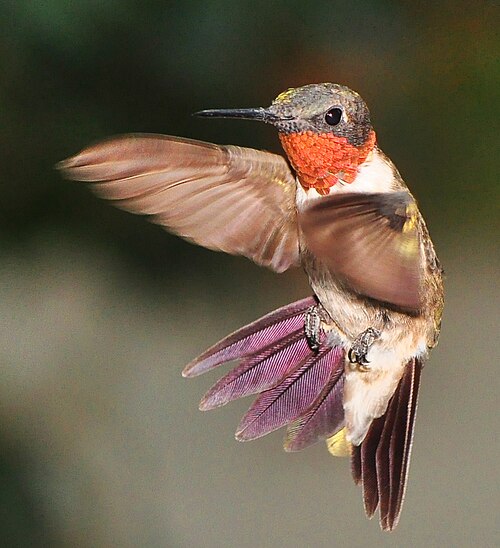
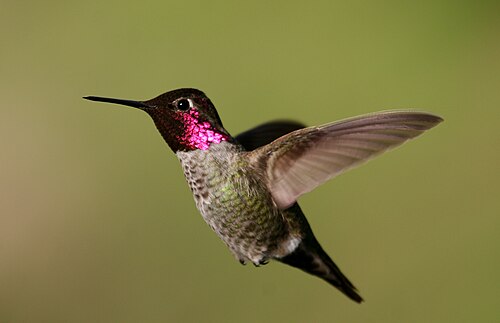
Licensed photographs of this species — heroes, eras and icons on one wall.
Charles J. SharpCharles J. SharpjeffreywRobert McMorran, United States Fish and Wildlife ServiceAndy Morffew from Itchen Abbas, Hampshire, UKCharles J. SharpUnknown authorNate Lee
The profile
Speed91
Intelligence48
Range58
Resilience73
Cultural impact34
Ecological role76
Pin anatomy against behaviour
Pick one anatomy system and one operating fact already on this species page. A reading pair — not a winner board.
Browsing aid inside this atlas. Field biology and local law decide any real encounter. No live feed.
How can a hummingbird hover when other birds cannot?
The shoulder allows a nearly horizontal figure-eight. Lift on the upstroke as well as the downstroke pays the hover bill that a typical avian stroke cannot.
Do hummingbirds live on sugar water alone?
No. Nectar is fuel. Arthropods supply protein, especially for chicks. Feeders that omit insects do not replace a territory.
How does a 3-gram bird cross the Gulf of Mexico?
Ruby-throated hummingbirds fatten, then fly 800+ km nonstop. Tailwinds and a high mass-specific power output make the crossing possible, not a rest on ships.
What is torpor in hummingbirds?
A controlled drop in body temperature and metabolic rate overnight. Without it, many species would exhaust nectar stores before sunrise.
Are hummingbirds only tropical?
Diversity peaks in the Andes. Anna’s hummingbirds now winter in Vancouver gardens; ruby-throated breed to southern Canada.
Who first illustrated hummingbirds for Europe?
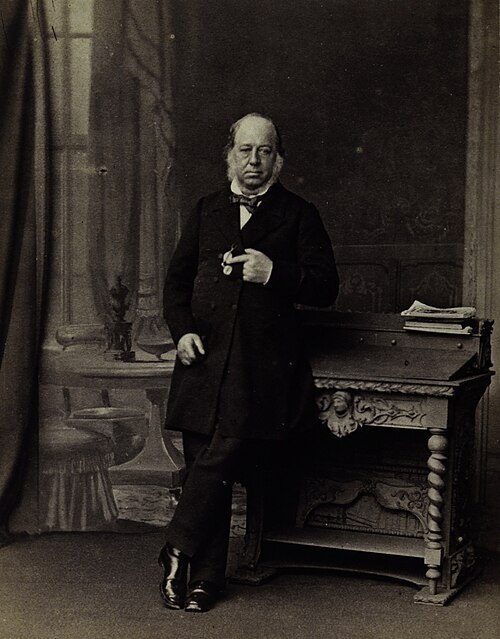
John Gould’s 19th-century monographs and skins made trochilids a Victorian craze — with a collecting cost that modern field work still cites.
Why do some species have bills longer than the head?
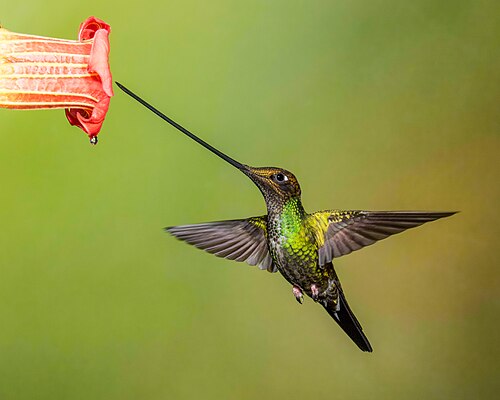
Sword-billed hummingbirds match 10–14 cm bills to Datura and Passiflora corollas — a coevolution exhibit, not an ornament.
Is feeder sugar a conservation tool?
Feeders help watchers and some urban birds. Habitat corridors and native tubular plants decide whether migrants still find the Gulf’s far shore.
Role, not a winner
Conservation literacy. Not a live IUCN fetch.
Embed this ranking
Paste this code into your blog or site — the ranking stays up to date.
Copied!
Similar species
Closest neighbours on the six atlas axes — speed, intelligence, range, resilience, culture and ecological role.