Darker cells mean a higher score for this topic on that metric.
LessMore
Last reviewed Sources & creditsMedia creditsMethodology
Quick answers
Did wolves recover everywhere?
Global LC hides Mexican wolves, some European growing pains, and US delisting fights. Resilience here is mid-high because many Holarctic populations rebounded -- not because conflict ended.
What happened in Yellowstone in 1995?
Fourteen wolves from Canada were released (more in 1996). Elk behaviour and riparian vegetation became a long argument, not a cartoon instant forest.
Is the trophic cascade settled?
Early popular accounts over-simplified. Later work kept wolves important and added drought, human hunting, and beaver. The cascade is a research programme, not a poster.
Who was Aldo Leopold here?
A forester who had killed wolves and later wrote the mountain-as-ethics essay (1949). The US environmental canon still starts many wolf talks there.
What is Isle Royale?
A closed wolf-moose system studied since 1958. Inbreeding and later genetic rescue (2018-) made it a lab of isolation.
Are wolves more intelligent than big cats in this atlas?
Pack coordination and canine social cognition sit high. Gorillas and elephants still outrank them. Scores are relative, not IQ certificates.
IUCN: Least Concern (global)
Anatomy overlay
Numbered teaching hotspots on the species still — not a clinical diagnosis.
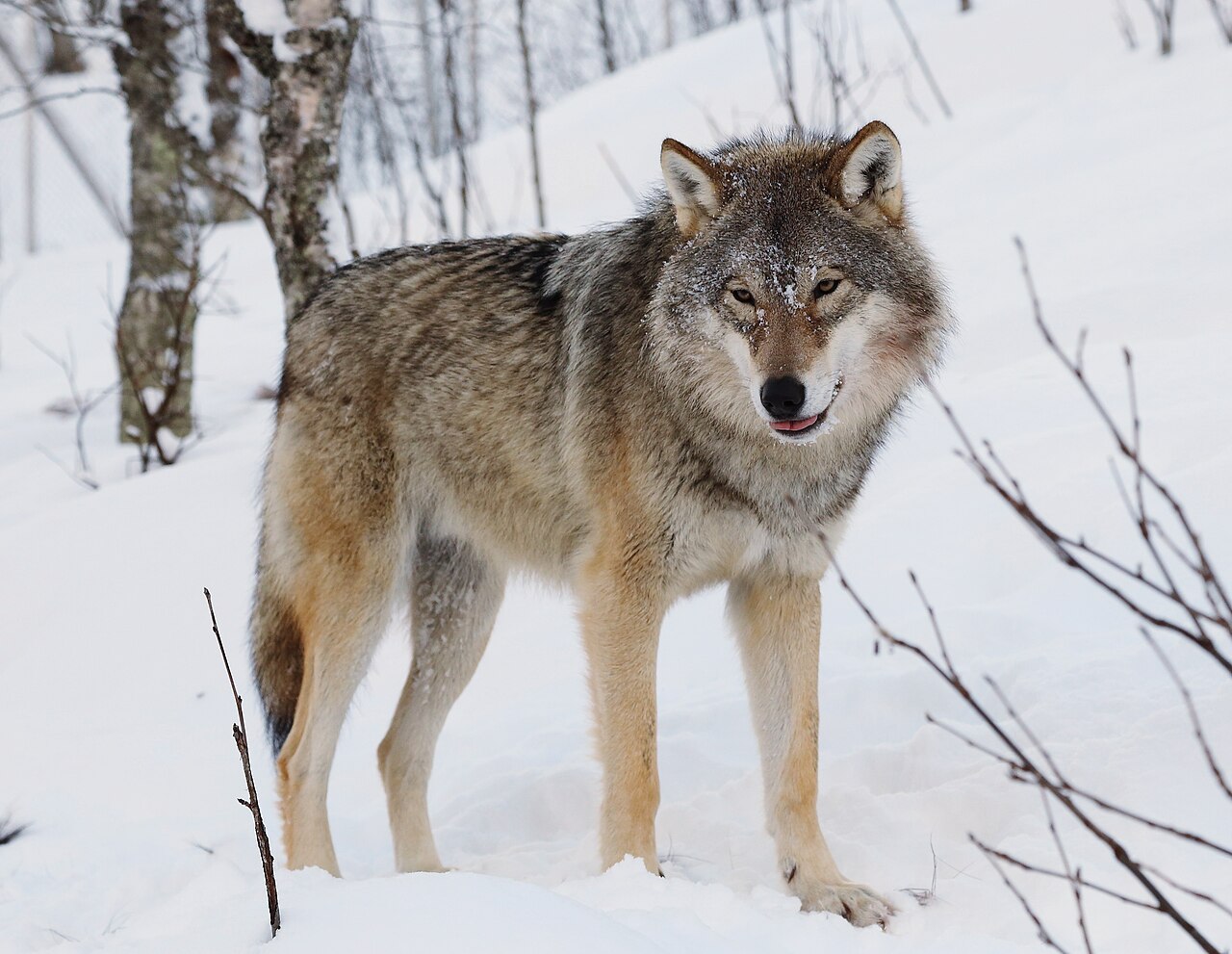
- 1 Primary weapon or tool — The bill, teeth, trunk, pouch or talon that field guides name first -- and that trade or c
- 2 Energy store — Fat, cache, crop or bamboo hours that decide whether a season closes.
- 3 Natal or breeding site — A redd, eyrie, den, anemone or ice lair -- often a single-point risk (Izumi, Natron, Gir).
- 4 Sensory organ — Smell and a howl that spaces packs. Night hunts use hearing as much as the postcard stare.
- 5 Human interface — Hunt, tourism, film or quota -- the surface where gray wolf biology meets English-language
Every gray wolf is a stack of tissues that must agree under season, prey and human pressure.
Meters below repeat the six atlas scores as gauges; they are relative marks, not laboratory certificates.
Systems
Support and integument
A long-legged canid with a sagittal crest for temporalis muscle and a dentition for both flesh and bone. Packs are families more often than Hollywood armies.
Feeding apparatus
Endurance chase and ambush on ungulates; winter moose or elk, summer more deer and beaver. Scavenge is ordinary. The feeding kit sets the ecological-role score relative to the other 23 types.
Respiration and circulation
Gas exchange and blood flow are tuned to the gray wolf energy budget -- dive, hover, sprint or bulk browse -- not to a generic vertebrate template.
Senses and neural control
Smell and a howl that spaces packs. Night hunts use hearing as much as the postcard stare.
Reproduction and ontogeny
Replacement rate is the hidden resilience number. Lead, poison, and a ballot. LC globally does not retire a rancher or a Mexican-wolf recovery plan.
Thermoregulation and salt/water
Climate and osmoregulation bound where a gray wolf can close its daily budget. Field sites in the English-speaking world still measure that envelope first.
Relative meters
Hotspots
Primary weapon or tool
The bill, teeth, trunk, pouch or talon that field guides name first -- and that trade or conflict usually targets.
Energy store
Fat, cache, crop or bamboo hours that decide whether a season closes.
Natal or breeding site
A redd, eyrie, den, anemone or ice lair -- often a single-point risk (Izumi, Natron, Gir).
Sensory organ
Smell and a howl that spaces packs. Night hunts use hearing as much as the postcard stare.
Human interface
Hunt, tourism, film or quota -- the surface where gray wolf biology meets English-language law.
Tissues & materials
Keratin and integument
Feathers, fur, baleen or skin plates -- tissues, not metals. Moult and wear are the maintenance cycle.
Bone and cartilage
Load paths for stoop, lunge, knuckle-walk or hover. Marrow and pneumatic bone differ by family.
Muscle and tendon
The expensive tissue that speed and intelligence scores only hint at.
Fat, oil and glycogen
Stores that migration, fast and lactation spend. A market for those stores (oil, ivory, fin) is a historical threat.
Keep exploring
More in Wildlife
Tiger
Asia largest cat — subspecies maps, 1973 Project Tiger, and roughly 4,000 remaining wild animals still frame a century of recovery arithmetic.
Overall 62 🦁Lion
A social pantherine whose prides, Gir relic and 2015 Cecil killing still structure African conservation politics.
Overall 66 🐘African bush elephant
The atlas type is the bush elephant -- an ecosystem engineer whose ivory ban (1989) and split from forest elephants still structure African conservation.
Overall 61 🐼Giant panda
A bamboo specialist whose WWF logo, Wolong quake and 2016 IUCN downlist from EN to VU made a recovery into a brand.
Overall 41 🐻Polar bear
A marine bear whose seal-and-ice budget made Churchill, Knut and climate models into one public animal.
Overall 56 🦍Gorilla
The atlas type is the western gorilla -- a knuckle-walking ape whose Fossey-era mountain cousins and Koko lab fame split one public name.
Overall 45 🐋Blue whale
The largest animal whose 1966 IWC protection, 1982 moratorium and still-thin Antarctic recovery define a hunted giant.
Overall 65