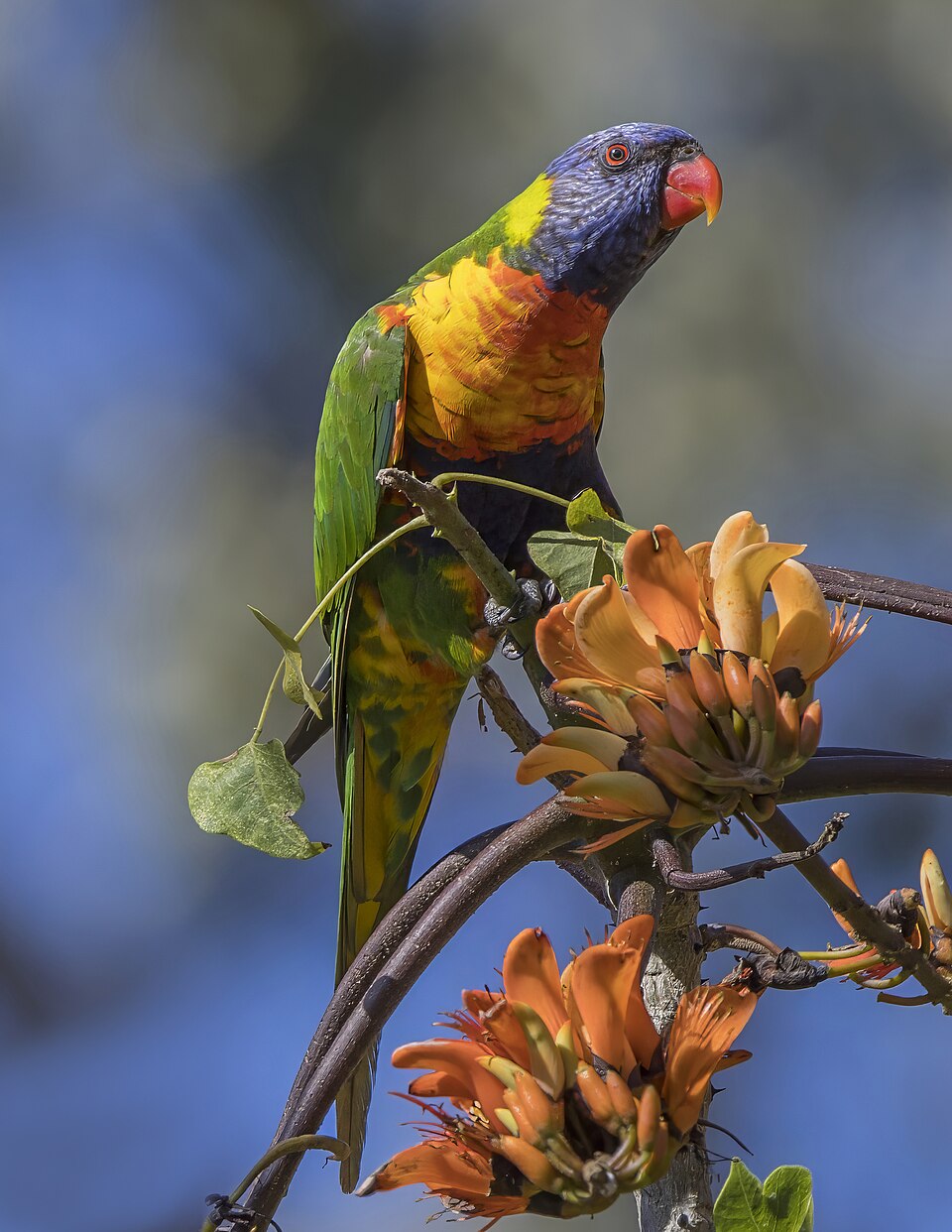
Deep time
Gondwana hookbills
Living diversity is Australasian, Neotropical and African; fossils show a wider Cenozoic map.
Parrot · Zygodactyl hookbills whose social brains, mimicry and nest-cavity needs collide with the cage trade.
Milestones in order. This is history, not a weekly activity grid.
Darker cells mean a higher score for this topic on that metric.
LessMore
Last reviewed Sources & creditsMedia creditsMethodology
Irene Pepperberg’s papers treated English tokens as categories, not circus tricks. Alex (1976–2007) identified colours, shapes and same/different above chance. The debate is about the ceiling, not whether the tasks happened.
Wild capture for pets plus forest loss cut Psittacus erithacus. Appendix I ended most commercial international trade in wild greys.
Every Strigops is named and managed on predator-free New Zealand islands. Supplementary feeding and nest cameras make it closer to intensive care than to a hands-off reserve.
They are an introduced boom, not a restored native. Cavity competition with starlings and bats is the local argument.
Cavity trees come down with forest. The pet trade added a second cut. Spix’s macaw went extinct in the wild before a 2019–20s reintroduction attempt in Bahia.
They learn contact calls in flocks. Human-word mimicry is the lab and living-room version of a general vocal-learning kit shared with songbirds and hummingbirds.
The parrot did not enter English as a finished emblem. Hunts, films, listings and field stations rewrote the animal on a dated clock.
This chapter keeps ten timeline points, five eras and three milestones so a later translation can hold the same years.
European Eocene fossils (e.g. Mopsitta debates) sit beside a Gondwanan living radiation.
Cyanopsitta spixii entered science; the wild population later collapsed to zero.
The grey that would anchor Pepperberg’s cognition series is born in the pet trade stream.
UK-founded NGO began funding in-situ work and trade data.
NZ’s programme treated each bird as a managed individual after island transfers.
Pepperberg’s book summarised two decades of label and category work.
Obituaries treated a lab parrot as a public scientist — rare for a research animal.
CITES CoP17 moved African greys to Appendix I.
Association for the Conservation of Threatened Parrots and Brazil prepared Bahia releases.
A strong breeding season pushed the managed population past 250 — still intensive care.
Living diversity is Australasian, Neotropical and African; fossils show a wider Cenozoic map.
Sailors and later airlines moved greys and macaws as talking cargo.
A single grey made parrot cognition a psychology topic.
NGOs and Appendix shifts tried to outrun the remaining wild trade.
Kakapo on cameras; ringnecks on London plane trees — opposite parrot futures.
Model/rival training produced publishable label use in a grey.
Commercial wild trade in African greys lost its main legal lane.
A flightless parrot became a named, transmitter-tagged national project.
Reading parrot history beside the resilience score keeps a recovered stock from standing in for a threatened cousin.
Apex diurnal raptors whose stoops, territories and national emblems stretch from taiga cliffs to tropical canopy.
Overall 75 🦉Nocturnal raptors whose facial discs, silent flight and asymmetric ears turn darkness into a hunting map.
Overall 72 🐧Flightless southern divers that turned wings into flippers and ice edges into commute routes.
Overall 56 🐦New World nectar specialists that hover on figure-eight wings and migrate on a few grams of fat.
Overall 63 🦩Long-legged filter feeders whose bent bills and carotenoid diets turn alkaline lakes into pink cities.
Overall 52 🪽Dynamic-soaring ocean birds whose metres-long wings and baited longlines now share the same latitudes.
Overall 58 🦢Tall wetland dancers whose red-crowned East Asian population is the atlas type and a conservation bottleneck.
Overall 53