Princely hunt
Shikar centuries
Mughal and colonial hunts cut numbers before anyone ran a camera grid.
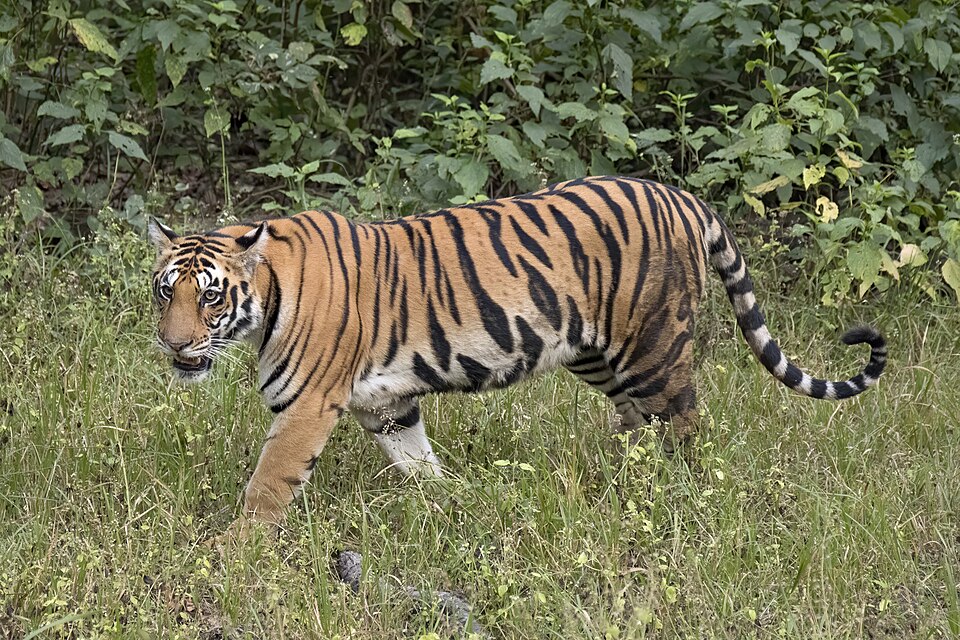
Tiger · Asia largest cat — subspecies maps, 1973 Project Tiger, and roughly 4,000 remaining wild animals still frame a century of recovery arithmetic.
Milestones in order. This is history, not a weekly activity grid.
Darker cells mean a higher score for this topic on that metric.
LessMore
Last reviewed Sources & creditsMedia creditsMethodology
Global estimates in the 2020s sit near 4,000-5,500 depending on the year and method. India holds the majority. The number is a camera-trap product, not a Victorian hunter tale.
India wild counts rose from a 1970s crisis to the largest national population. Methods changed (pugmarks to cameras), so the graph is not a single instrument. Southeast Asia did not copy the rebound.
A 2010 pledge by tiger-range states in St Petersburg to double wild numbers by 2022. Some countries gained; others lost. The slogan outlived the deadline.
Lions are Vulnerable with a wider African footprint and a tiny Gir relic. Tigers are Endangered, more forest-bound, and culturally heavier in South and East Asia. Scores stay relative across all 24 types.
A hunter of man-eaters who wrote Man-Eaters of Kumaon (1944) and later lent his name to India first national park -- a colonial-to-reserve arc.
Panthera tigris tigris now lumps many mainland tigers in some taxonomies; Amur animals still have a Russian-Chinese border programme and a different prey winter.
IUCN: Endangered
The tiger did not enter English as a finished emblem. Hunts, films, listings and field stations rewrote the animal on a dated clock.
This chapter keeps ten timeline points, five eras and three milestones so a later translation can hold the same years.
Pleistocene fossils already show large striped cats on the continent they still occupy.
United Provinces reserve that later became Jim Corbett National Park.
Corbett book that fixed the man-eater as an English-language type.
Indira Gandhi-era launch after a crisis count -- the policy that still structures India tigers.
A reserve became a global viewing economy; later tigress identities (Machli) followed.
Range states pledged a doubling by 2022.
All-India estimate used cameras more systematically -- a method break from pugmarks.
Official figures passed 2,200 -- celebrated, then debated for method.
Global double did not arrive uniformly; India claimed success, SE Asia did not.
Range-country reports kept mainland SE Asia on the wrong slope.
Mughal and colonial hunts cut numbers before anyone ran a camera grid.
Corbett-era reserves did not prevent a 1960s-70s crash.
India built a reserve bureaucracy other range states only partly copied.
A doubling pledge met camera maths and uneven politics.
One country holds most wild tigers; the map is not a species recovery.
A national project, not a charity poster, became the tiger state.
A diplomatic number that 2022 only partly honoured.
Method change that made later rises hard to compare with pugmark decades.
Reading tiger history beside the resilience score keeps a recovered stock from standing in for a threatened cousin.
A social pantherine whose prides, Gir relic and 2015 Cecil killing still structure African conservation politics.
Overall 66 🐘The atlas type is the bush elephant -- an ecosystem engineer whose ivory ban (1989) and split from forest elephants still structure African conservation.
Overall 61 🐺A Holarctic pack hunter whose 1995 Yellowstone return and older Leopold ethics still structure predator politics.
Overall 78 🐼A bamboo specialist whose WWF logo, Wolong quake and 2016 IUCN downlist from EN to VU made a recovery into a brand.
Overall 41 🐻A marine bear whose seal-and-ice budget made Churchill, Knut and climate models into one public animal.
Overall 56 🦍The atlas type is the western gorilla -- a knuckle-walking ape whose Fossey-era mountain cousins and Koko lab fame split one public name.
Overall 45 🐋The largest animal whose 1966 IWC protection, 1982 moratorium and still-thin Antarctic recovery define a hunted giant.
Overall 65