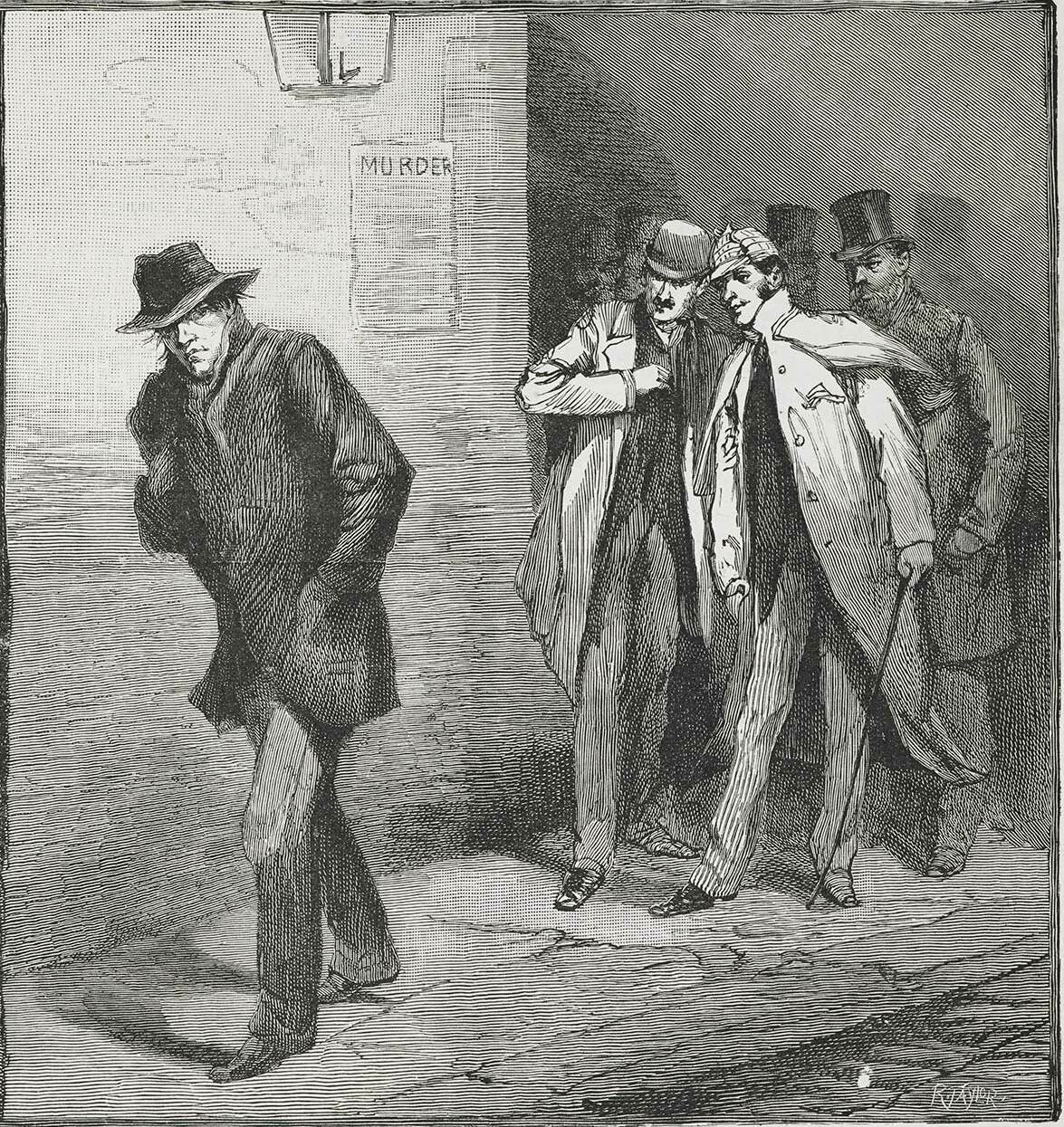
In autumn 1888 a still-unidentified killer murdered at least five adult women in Whitechapel; the police files, press letters and later historiography created the modern true-crime myth.
Also called: Whitechapel murders · autumn of terror
At a glance
Score intensity
Darker cells mean a higher score for this topic on that metric.
Notoriety97
Mystery95
Scale40
Evidence32
Legal impact45
Culture98
LessMore
Score profile
Each bar is a 0-100 atlas score for this topic, not a timeline.
Notoriety97
Mystery95
Scale40
Evidence32
Legal impact45
Culture98
Evidence
Evidence
32%
Score profile
Mystery
95%
Timeline
Milestones in order. This is history, not a weekly activity grid.
Between 31 August and 9 November 1888, five adult women — Mary Ann Nichols, Annie Chapman, Elizabeth Stride, Catherine Eddowes and Mary Jane Kelly — were murdered in Whitechapel and Spitalfields. Later writers call them the “canonical five,” a grouping popularised by Sir Melville Macnaghten’s 1894 memorandum, which stated that the Whitechapel murderer had five victims and five only. A wider Metropolitan Police file on Whitechapel murders runs from 1888 into 1891 and was never closed by a conviction.
Two forces worked the ground: the Metropolitan Police (H Division and CID) and, for the Mitre Square killing of Catherine Eddowes, the City of London Police. Named investigators include Inspector Frederick Abberline and, in later paperwork, Assistant Chief Constable Melville Macnaghten. Commissioner Sir Charles Warren resigned on 8 November 1888. The killer was never identified. Letters that gave the case its trade name — especially the “Dear Boss” letter of late September 1888 — are of disputed authenticity.
This page is an investigation and historiography file. It does not describe wounds, does not sexualise the dead and does not offer theories that could be read as a method. The victims were adult women living in East End poverty; several sold sex to survive. English-language culture later turned their deaths into a tourist brand. The public record is thinner than the brand.
DatesAug–Nov 1888
StatusUnsolved
DistrictWhitechapel
PoliceMet + City Police
VictimsCanonical five
Name originPress letters
Dossier scores
Notoriety 97
Mystery 95
Scale 40
Evidence 32
Legal impact 45
Culture 98
Notoriety
97
Mystery
95
Scale
40
Evidence
32
Legal impact
45
Culture
98
A file without a defendant
Jack the Ripper is the type unsolved investigation: a short autumn of police work, a thick press myth and a century of documents that name suspects without ever producing a trial.
What the 1888 police actually had
The contemporary file is inquests, beat reports, medical statements that this page will not quote for injury detail, and a small set of letters sent to press and to the Whitechapel Vigilance Committee. There was no fingerprint bureau in 1888, no blood-group work that could individualise a stranger, and no surviving crime-scene photography of the kind later readers expect.
Identity suspects accumulated anyway: local men, butchers, doctors, Jews scapegoated in the “Leather Apron” scare, and later gentlemen invented by memoir. Macnaghten’s 1894 memo, written to knock down a newspaper claim about Thomas Cutbush, named Montague John Druitt, “Kosminski” and Michael Ostrog as likelier than Cutbush — not as proven killers.
The name is a media object
“Jack the Ripper” entered English from a letter to the Central News Agency, published in late September 1888, signed with that name. A mid-October “From Hell” letter to George Lusk of the Vigilance Committee is a second famous document. Police and later historians have long treated many of the hundreds of letters as hoaxes, including possible press hoaxes.
The autumn press — The Star, the Illustrated Police News, the dailies — made Whitechapel a national theatre. That coverage is itself evidence of how a local murder series became an imperial-language myth. It is not evidence of who held the knife.
Historiography, not a second investigation
“Ripperology” is the hobby and academic industry that re-reads the same thin file. Donald Rumbelow, Stewart Evans, Paul Begg and others professionalised source criticism. Philip Sugden’s historical survey remains a standard English caution against late naming. The canonical five is a historians’ convenience, not a 1888 statute.
Twenty-first-century DNA claims, notably a 2014 mitochondrial argument around a shawl said to be linked to Catherine Eddowes and to Aaron Kosminski, were widely disputed on provenance and on what mitochondrial DNA can prove. They did not reopen a court. Unsolved remains the correct status.
What the case did to policing and memory
Immediate legal change was modest compared with Titanic or Chernobyl. The murders fed arguments about beat strength, Jewish immigration, housing and the ethics of a sensational press. Warren’s resignation is a political date, not a confession of a missed arrest.
Cultural change was vast. From penny dreadfuls to cinema, the unidentified killer became a costume. Responsible English reference returns to the five named adult women, the two police forces and the 1894 memo — and leaves the fog on the poster.
Beat weight marks
Mark each timeline beat already on this dossier as supported, contested or unknown, using the public-record claims already filed here. Not a verdict.
Editorial marks on this device only. Public-record encyclopedia — not legal advice, not a how-to, not a private file.
Timeline beat
Supported / Contested / Unknown
31 Aug 1888 — Mary Ann Nichols
Claim already on file: A royal physician or a Masonic plot is the official solution.
8 Sep 1888 — Annie Chapman
Claim already on file: DNA has solved the case.
27 Sep 1888 — “Dear Boss” letter dated
Claim already on file: The killer’s name was Jack as a given name.
30 Sep 1888 — Stride and Eddowes
Claim already on file: The victims were nameless or not adults.
16 Oct 1888 — Lusk letter
Claim already on file: The victims were nameless or not adults.
8 Nov 1888 — Warren resigns
Claim already on file: The victims were nameless or not adults.
9 Nov 1888 — Mary Jane Kelly
Claim already on file: The victims were nameless or not adults.
1889–91 — Wider Whitechapel file
Claim already on file: The victims were nameless or not adults.
Feb 1894 — Macnaghten memorandum
Claim already on file: The victims were nameless or not adults.
2014 — Disputed DNA claim
Claim already on file: The victims were nameless or not adults.
An unidentified murderer of adult women in Whitechapel in 1888. The name comes from press letters, not from a charging document. No one was convicted. Status is unsolved.
Who were the canonical five?
Mary Ann Nichols (31 August), Annie Chapman (8 September), Elizabeth Stride and Catherine Eddowes (30 September) and Mary Jane Kelly (9 November), all 1888. Macnaghten’s 1894 memorandum fixed the five-victim claim that later historians call canonical. Other Whitechapel murders in 1888–91 are in the wider police file.
Were the victims adult women?
Yes. The canonical five were adult women living in East End poverty. Several sold sex to survive. This page does not sexualise them or describe their bodies. They are named because the inquests named them.
Why was the case never solved?
No suspect was charged with the series. Forensic tools of 1888 could not individualise a stranger. Witness descriptions conflicted. Letters confused the public file. Later memoirs named names without producing trial evidence.
Are the Jack the Ripper letters genuine?
Some may be. Many are not. The “Dear Boss” letter that supplied the name is often judged a possible journalist’s hoax. The “From Hell” letter to George Lusk is debated separately. Hundreds of other letters are treated as copycat or crank mail.
Did DNA identify the killer?
No court has accepted such an identification. A 2014 mitochondrial-DNA claim tied to a disputed shawl and to Aaron Kosminski was criticised for chain of custody and for the limits of that DNA type. It did not close the case.
What official documents matter most?
The inquest files, surviving Metropolitan and City police papers, the 1894 Macnaghten memorandum, and later memoirs by officials such as Sir Robert Anderson — the last to be read as memory, not as a verdict.
Is this a gore story?
Not here. The public-record subject is investigation, press and historiography. Clinical notes exist in archives; this encyclopedia does not repeat them.