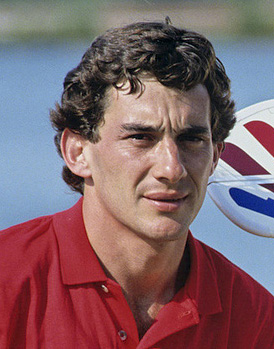
Ayrton Senna
Niki Lauda
Stat by stat
Bars are scaled to the leader in this list.
The verdict
Ayrton Senna leads 4 of 5 categories. Our all-time ranking places Ayrton Senna at #4 and Niki Lauda at #11.
Head-to-head FAQ
Who leads more shared metrics?
How do the published ranks compare?
Are these live stats?
The case for Ayrton Senna
The greatest qualifier the sport has seen: 65 pole positions in 161 starts, a 40 percent pole rate achieved against Prost, Mansell and Piquet in their primes. Senna's three titles — 1988, 1990, 1991 — and 41 wins undersell a talent defined by singular performances: the 1988 Monaco qualifying lap 1.4 seconds faster than Prost in an identical McLaren; six Monaco wins, still the record; Donington 1993, passing four cars on the opening lap in the wet in an inferior Williams-beating McLaren; Estoril 1985, winning by over a minute in the rain in an uncompetitive Lotus. His rivalry with Prost — title-deciding collisions at Suzuka in 1989 and 1990 — remains the sport's defining feud, and his ruthlessness at Suzuka 1990 is the asterisk on his record. Killed at Imola on 1 May 1994 at 34, leading the race, he remains the sport's great unfinished argument: on peak, perhaps the fastest ever.
The case for Niki Lauda
Three titles and 25 wins, but no career in the sport's history carries more narrative weight per statistic. Lauda bought his way into Formula 1 with a bank loan, made Ferrari champions again in 1975, and then, in August 1976, crashed at the Nurburgring, suffered burns and lung damage severe enough that a priest administered the last rites — and raced again 42 days later at Monza, finishing fourth with wounds still bleeding under his balaclava. He lost that title by one point after withdrawing from the monsoon at Fuji, a decision he never regretted, then reclaimed the championship in 1977 with clinical points accumulation. Retired in 1979, he returned in 1982 with McLaren and won the 1984 title by half a point — the closest margin ever — over his young teammate Prost. The purest embodiment of the calculating, risk-pricing professional driver, and the sport's greatest comeback, twice over.