Lewis Hamilton
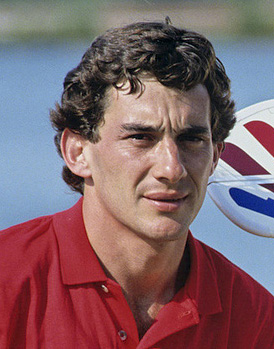
Ayrton Senna
Stat by stat
Bars are scaled to the leader in this list.
The verdict
Lewis Hamilton leads 5 of 5 categories. Our all-time ranking places Lewis Hamilton at #1 and Ayrton Senna at #4.
Head-to-head FAQ
Who leads more shared metrics?
How do the published ranks compare?
Are these live stats?
The case for Lewis Hamilton
The statistical summit of the sport: seven world titles, tying Schumacher, plus all-time records of 105 wins, 104 pole positions and more than 200 podiums as of the end of 2024. The breadth is the argument — Hamilton won races in every season from 2007 to 2021, a fifteen-year streak no one else approaches, and won titles in three distinct regulation eras with V8 and hybrid machinery. He nearly took the championship as a rookie in 2007, beat double champion Alonso on points in the same car, and his 2020 season — 11 wins, a seventh title sealed with a wet-weather masterclass in Turkey — came at age 35. The counterargument is machinery: Mercedes was the class of the field for most of 2014 to 2020. But he beat every teammate over a season bar Rosberg in 2016 and Russell in 2024, and lost the 2021 title only on the final lap. His 2025 move to Ferrari extended the longest elite career of the modern era.
The case for Ayrton Senna
The greatest qualifier the sport has seen: 65 pole positions in 161 starts, a 40 percent pole rate achieved against Prost, Mansell and Piquet in their primes. Senna's three titles — 1988, 1990, 1991 — and 41 wins undersell a talent defined by singular performances: the 1988 Monaco qualifying lap 1.4 seconds faster than Prost in an identical McLaren; six Monaco wins, still the record; Donington 1993, passing four cars on the opening lap in the wet in an inferior Williams-beating McLaren; Estoril 1985, winning by over a minute in the rain in an uncompetitive Lotus. His rivalry with Prost — title-deciding collisions at Suzuka in 1989 and 1990 — remains the sport's defining feud, and his ruthlessness at Suzuka 1990 is the asterisk on his record. Killed at Imola on 1 May 1994 at 34, leading the race, he remains the sport's great unfinished argument: on peak, perhaps the fastest ever.