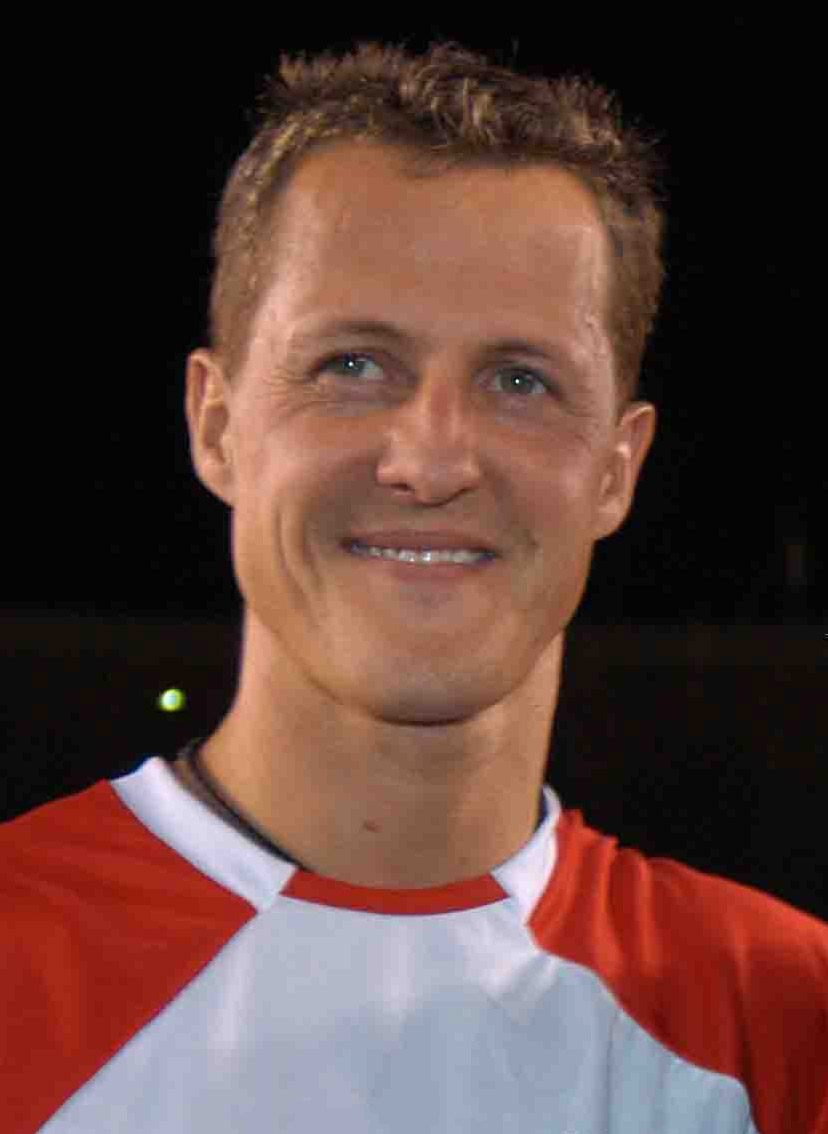
Michael Schumacher
Niki Lauda
Stat by stat
Bars are scaled to the leader in this list.
The verdict
Michael Schumacher leads 4 of 4 categories. Our all-time ranking places Michael Schumacher at #2 and Niki Lauda at #11.
Head-to-head FAQ
Who leads more shared metrics?
How do the published ranks compare?
Are these live stats?
The case for Michael Schumacher
Schumacher redefined what a Formula 1 driver's job was. Beyond the seven titles, 91 wins and 155 podiums, he was the first modern driver to treat the entire team as his instrument — famously fit, relentless in testing, fluent in the engineering, and the organising force around which Ferrari rebuilt itself. After titles with Benetton in 1994 and 1995, he joined a Ferrari team that had not crowned a champion since 1979 and dragged it through four painful seasons before delivering five consecutive titles from 2000 to 2004, the last with 13 wins in 18 races. His 77 fastest laps stood as the record for years and signal his defining trait: sustained qualifying-speed stints on demand, the skill that made refuelling-era strategy work. The stains are real — Adelaide 1994, Jerez 1997, Monaco 2006 — and they cost him the top spot here, but his peak-era command of a race weekend has never been exceeded.
The case for Niki Lauda
Three titles and 25 wins, but no career in the sport's history carries more narrative weight per statistic. Lauda bought his way into Formula 1 with a bank loan, made Ferrari champions again in 1975, and then, in August 1976, crashed at the Nurburgring, suffered burns and lung damage severe enough that a priest administered the last rites — and raced again 42 days later at Monza, finishing fourth with wounds still bleeding under his balaclava. He lost that title by one point after withdrawing from the monsoon at Fuji, a decision he never regretted, then reclaimed the championship in 1977 with clinical points accumulation. Retired in 1979, he returned in 1982 with McLaren and won the 1984 title by half a point — the closest margin ever — over his young teammate Prost. The purest embodiment of the calculating, risk-pricing professional driver, and the sport's greatest comeback, twice over.