Milestones in order. This is history, not a weekly activity grid.
- The first Grand Prix
- The world championship begins
- Fangio's fifth title
- Constructors' Cup and the rear-engine dawn
- The monocoque revolution
- Money and wings arrive
- Lauda, Hunt and the year of the comeback
- Ground effect perfected
- McLaren's near-perfect season
- The black weekend at Imola
- Schumacher's seventh
- The Brawn GP fairy tale
- The hybrid era begins
- Liberty Media buys the sport
Last reviewed Sources & creditsMedia creditsMethodology
Quick answers
Why is it called Formula 1?
The formula is the set of technical regulations every car must meet — engine size, weight, dimensions, aerodynamics — and Formula One designates the top tier of that rules ladder, above Formula 2 and Formula 3. The FIA codified the modern formula in 1946, drawing on pre-war Grand Prix regulations, and attached a world championship to it from 1950. So the name literally means the number-one rule set of single-seater racing. The regulations are rewritten periodically — 2014 introduced hybrid power units, 2022 reintroduced ground effect, and 2026 brings the next full reset — which is why the cars, and often the competitive order, change so dramatically between eras while the name stays the same.
How fast do F1 cars actually go?
The highest speed recorded in a race is 372.5 km/h, set by Valtteri Bottas at the 2016 Mexican Grand Prix with a slipstream at high altitude; typical top speeds at circuits like Monza are 340 to 360 km/h. Raw straight-line speed is not the point, though — plenty of cars go faster. What defines F1 is cornering: downforce lets cars take corners at loads above 5g, brake from 300 km/h to 100 km/h in well under two seconds, and lap circuits faster than any other racing car. The fastest average lap in history is Lewis Hamilton's 2020 Monza pole at 264.362 km/h — an entire lap, corners included, at over 260 km/h average.
Who is the greatest F1 driver of all time?
By raw numbers, Lewis Hamilton: seven titles equal with Michael Schumacher, plus outright records of 105 wins and 104 pole positions as of the end of 2024. Schumacher's advocates cite five consecutive titles and his rebuilding of Ferrari; Juan Manuel Fangio won 24 of his 52 championship entries in the 1950s, a strike rate no one has approached; Ayrton Senna is widely held the fastest over one lap; and Max Verstappen's 19-win 2023 season is statistically the most dominant ever. There is no settled answer because equipment quality varies so much between drivers — the most honest tiebreaker is performance against teammates in identical cars, and by that measure Hamilton, Fangio and Verstappen all have elite cases.
How much does it cost to run a Formula 1 team?
Since 2023 teams operate under a cost cap of 135 million dollars per season for car design, development and racing operations — but that excludes driver salaries, the three highest-paid staff, marketing, engine programmes and capital projects, so real total budgets at top teams still comfortably exceed 300 million dollars a year. Before the cap arrived in 2021, Mercedes, Ferrari and Red Bull were each spending upwards of 400 million annually. Power units are covered by a separate cost cap for manufacturers. The individual hardware is startling: a single power unit is valued in the millions, a front wing in the hundreds of thousands, and crash damage is tracked lap by lap because it now eats directly into development budget.
What is DRS and how does it work?
DRS — the Drag Reduction System, introduced in 2011 — is a driver-operated flap in the rear wing that opens to reduce drag and boost straight-line speed by roughly 10 to 12 km/h. It can only be used in designated activation zones, and only if the pursuing car is within one second of the car ahead at a detection point just before the zone; it closes automatically when the driver brakes. The system exists to offset dirty air, the turbulence that costs a following car downforce and makes passing difficult. Critics call its passes artificial; defenders note it merely restores an attack that aerodynamics took away. From 2026 DRS is replaced by active aerodynamics on all cars plus a push-to-pass style manual energy override.
Why don't F1 cars refuel during pit stops?
Refuelling was banned from 2010, on cost and safety grounds — teams hauled heavy rigs around the world, and the era produced fires and botched releases, most famously Jos Verstappen's 1994 pit fire at Hockenheim. Cars now start with all their race fuel, up to 100 kilograms, and pit stops change tyres only, which is why they take under two and a half seconds; the all-time record is McLaren's 1.80-second stop at the 2023 Qatar Grand Prix. The ban reshaped racing strategy: with no fuel-length gambits, tyre management became the central strategic variable, and drivers must manage a car that is dramatically heavier and slower in the opening stint than at the flag.
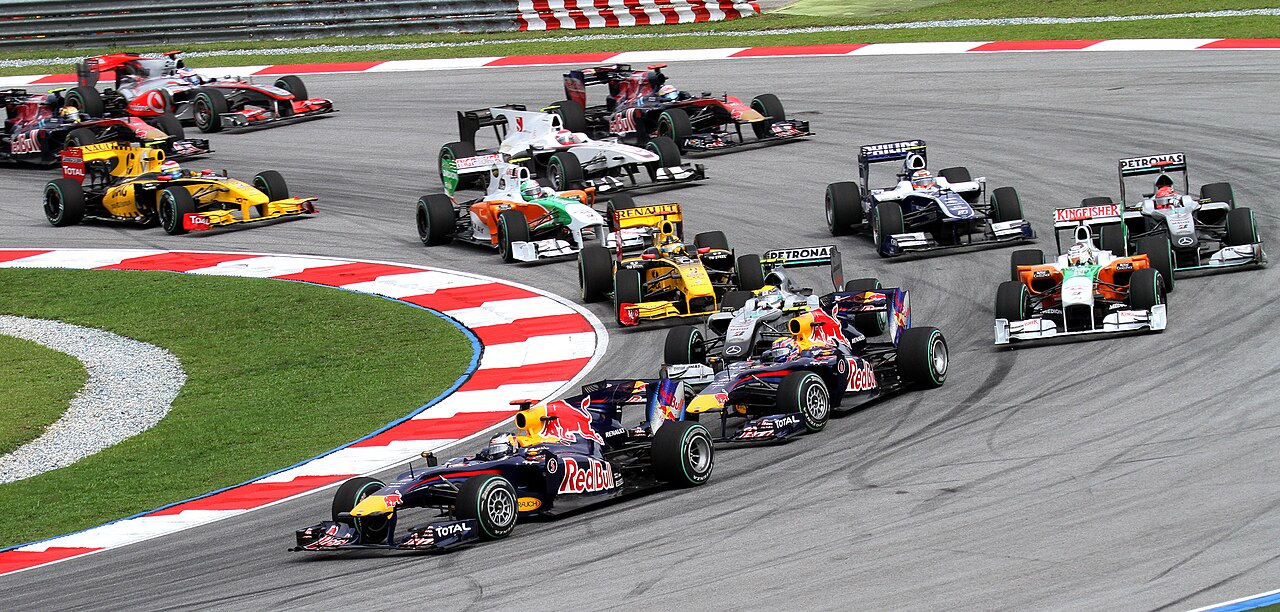
Grand Prix racing predates the championship by decades — the Automobile Club de France ran the first race called a Grand Prix at Le Mans in 1906 — but Formula 1 proper begins with the FIA's post-war decision to codify a set of rules, a formula, for the top class of single-seaters and hang a world championship on it. The first round was held at Silverstone on 13 May 1950 in front of the British royal family, and Giuseppe Farina won it in a supercharged Alfa Romeo 158 designed before the war.
Everything since is a story of successive revolutions, each one obsoleting the grid that came before it: engines moved behind the driver, chassis became monocoques, wings and then sculpted floors pressed cars into the road, turbochargers arrived twice, and electronics crept into every system. Threaded through the technology is the human arc — from an era in which a driver had a meaningful chance of dying in any given season, to a sport that has not lost a driver in a championship race since 1994, a transformation earned in the worst possible way.
Timeline
The Automobile Club de France stages the inaugural Grand Prix on a 103 km road circuit at Le Mans. Ferenc Szisz wins for Renault over two days of racing, establishing the template every national Grand Prix would follow.
The first Formula 1 World Championship race is held at Silverstone on 13 May. Giuseppe Farina wins in an Alfa Romeo 158 and takes the inaugural title from teammate Juan Manuel Fangio.
At the Nurburgring, a 46-year-old Fangio hunts down the Ferraris of Hawthorn and Collins after a botched pit stop, repeatedly smashing the lap record. The win seals a fifth title, a record that stands for 46 years.
The Constructors' Championship is introduced and won by Vanwall, while Stirling Moss takes Argentina in Rob Walker's rear-engined Cooper — the layout that makes every front-engined car obsolete within three seasons.
Colin Chapman's Lotus 25 replaces the spaceframe with a riveted aluminium monocoque tub — stiffer, lighter and safer. Jim Clark uses its descendants to win the 1963 and 1965 titles with crushing superiority.
Lotus paints its cars in Gold Leaf tobacco livery, ending national racing colours and starting the sponsorship age, while Ferrari and Brabham bolt the first aerofoils onto their cars at Spa. Downforce changes the sport forever.
Niki Lauda is given the last rites after his fiery Nurburgring crash, returns 42 days later at Monza, then withdraws from the rain-soaked Fuji finale. James Hunt takes the title by a single point.
The Lotus 79's underbody venturi tunnels and sliding skirts generate downforce with little drag; Mario Andretti wins the championship and Lotus takes eight victories. Every rival must copy the concept or lose.
The Honda-powered McLaren MP4/4 of Senna and Prost wins 15 of 16 races, with Senna taking 13 pole positions and his first title. It remains the benchmark for single-season dominance.
Roland Ratzenberger dies in qualifying and Ayrton Senna dies leading the San Marino Grand Prix on 1 May. The sport responds with a permanent safety revolution: circuit redesigns, crash-test escalation and the FIA's research programme.
Michael Schumacher wins 13 of 18 races for Ferrari and clinches a record seventh title and fifth in a row, capping a partnership with Ross Brawn, Rory Byrne and Jean Todt that won six straight constructors' crowns from 1999.
Rising from Honda's withdrawal, Ross Brawn's team exploits the double-diffuser loophole; Jenson Button wins six of the first seven races and the title in the team's only season of existence.
F1 adopts 1.6-litre V6 turbo-hybrid power units with energy recovery from braking and exhaust heat. Mercedes masters the formula first and wins eight consecutive constructors' titles from 2014 to 2021.
Liberty Media completes its roughly 8-billion-dollar acquisition of Formula One Group in January, ending Bernie Ecclestone's four-decade reign and pivoting the sport toward digital media, new fans and the American market.
In a pandemic-shortened season, Lewis Hamilton takes his 91st win at the Nurburgring to equal Schumacher's record, passes it at Portimao, and clinches a seventh title in Turkey with a wet-weather masterclass.
The first season under a budget cap ends with Max Verstappen passing Hamilton on the final lap of the final race after a contentious safety-car restart — the closest and most disputed title decider of the modern era.
A clean-sheet regulation reintroduces underbody venturi tunnels to let cars follow closely. Red Bull's RB18 and RB19 dominate; the RB19 wins 21 of 22 races in 2023, the highest team win rate in history.
The calendar reaches a record 24 rounds. Verstappen withstands McLaren's late-season resurgence to seal a fourth consecutive championship, while the constructors' title goes to McLaren for the first time since 1998.
The eras
The Founding Giants
The championship's first decade belonged to pre-war engineering culture and post-war heroism. Alfa Romeo's supercharged 158/159, a 1930s design, won everything in 1950-51 before Ferrari's unblown 4.5-litre cars broke the streak at Silverstone in 1951. The towering figure was Juan Manuel Fangio, who took five titles between 1951 and 1957 with four different constructors — Alfa Romeo, Mercedes, Ferrari and Maserati — a feat of political as well as sporting genius. Mercedes' 1954-55 W196, with desmodromic valves and streamlined bodywork, showed what a major manufacturer could do before the Le Mans disaster of 1955 pushed the company out of racing. The era's pivot came from a small British garage: Cooper mounted its Climax engine behind the driver, Stirling Moss won Argentina 1958 in one, and Jack Brabham took the 1959 and 1960 titles. By 1961 every serious car was rear-engined, and the age of the Italian thoroughbred front-engined racer was over. Racing was staggeringly lethal: drivers raced in cotton polo shirts on circuits lined with trees, and dozens died across the decade.
Garagistes, Wings and the Price of Speed
Colin Chapman's Lotus 25 monocoque of 1962 began British constructor hegemony — Enzo Ferrari's dismissive term garagisti became a badge of honour as Lotus, Brabham, McLaren and Tyrrell out-innovated the factories. Jim Clark was the era's defining talent, taking the 1963 and 1965 titles and winning the 1965 Indianapolis 500 in the same season; his death in a Formula 2 race at Hockenheim in April 1968 shattered the sport's fatalism into something like conscience. That same year brought two permanent changes: commercial sponsorship, as Lotus abandoned British racing green for Gold Leaf red and gold, and aerodynamic wings, which appeared at Spa and within months were generating loads that snapped their mountings. The Cosworth DFV engine, introduced in 1967 at 400 horsepower and sold to anyone with 7,500 pounds, democratised competitiveness and won 155 Grands Prix over 16 years. Jackie Stewart won three titles while waging a furious safety campaign — barriers, seatbelts, full-face helmets, circuit boycotts — that made him unpopular in the paddock and saved uncounted lives. The era closed with 1976's Lauda-Hunt duel, decided by a single point after Lauda's near-fatal Nurburgring fire.
Ground Effect, Turbos and Senna versus Prost
Two technologies defined the period. Lotus discovered ground effect — shaping the underbody as an inverted wing sealed by sliding skirts — and the 1978 Lotus 79 gave Mario Andretti the title with ease before flat-bottom rules banned the concept in 1983. Renault arrived at Silverstone in 1977 with a 1.5-litre turbocharged engine that was mocked as the yellow teapot, then vindicated as turbo power climbed toward an estimated 1,300-plus horsepower in qualifying trim by 1986, when every winning car was turbocharged. McLaren's Honda-powered MP4/4 won 15 of 16 races in 1988, the stage for the sport's greatest rivalry: Ayrton Senna and Alain Prost, teammates and enemies, collided at Suzuka in both 1989 and 1990 with world titles decided each time. Turbos were banned for 1989; electronics filled the vacuum, culminating in the Williams FW14B of 1992, whose active suspension, traction control and semi-automatic gearbox helped Nigel Mansell win nine races. Prost took his fourth title in 1993 in the equally clever FW15C, after which most driver aids were banned — a decision whose consequences arrived brutally the following spring.
The Safety Rebuild and the Schumacher Empire
Imola 1994 — Roland Ratzenberger killed in qualifying, Ayrton Senna killed leading the race — forced the modern safety era into existence: gravel traps and barriers reworked, cockpit sides raised, crash tests escalated year over year, the HANS device eventually mandated in 2003, and Sid Watkins' medical infrastructure professionalised. Competitively, the period belonged to Michael Schumacher. He took the 1994 title by one point after a collision with Damon Hill in Adelaide, won again in 1995, then moved to a Ferrari team that had not won a drivers' championship since 1979. With Jean Todt, Ross Brawn and Rory Byrne he built the most successful team structure the sport had seen: five consecutive drivers' titles from 2000 to 2004, six straight constructors' championships from 1999, and a 2004 season with 13 wins from 18 races. Refuelling, reintroduced in 1994, turned races into sequences of qualifying-speed stints where passes happened in the pits. The era ended with two of the sport's tightest finishes — Raikkonen's 2007 title by one point, and Hamilton's 2008 crown won on the final corner of the final lap in Brazil.
Aero Wars and the Hybrid Hegemony
Brawn GP's 2009 double-diffuser title from the ashes of Honda's withdrawal opened a decade in which aerodynamic loopholes decided championships: Red Bull's Adrian Newey answered with the exhaust-blown diffuser era, and Sebastian Vettel won four straight titles from 2010 to 2013, becoming the youngest champion at 23 and closing 2013 with nine consecutive wins. Refuelling was banned from 2010, making tyre management the core racing skill, and DRS arrived in 2011 to fight the growing dirty-air problem. The 2014 switch to 1.6-litre V6 turbo-hybrids — power units exceeding 50 percent thermal efficiency, the most efficient racing engines ever built — handed Mercedes a structural advantage it converted into eight consecutive constructors' titles and seven drivers' championships for Lewis Hamilton, whose intra-team war with Nico Rosberg (Rosberg won 2016, then retired within days) provided the era's sharpest drama. Liberty Media's 2017 takeover and 2019's Drive to Survive rebuilt the audience while the racing stagnated up front. The era ended at Abu Dhabi 2021, Verstappen against Hamilton, settled on the last lap under a safety-car procedure so contested that race director Michael Masi lost his job.
Cost Caps, Ground Effect Redux and the Verstappen Era
The 2022 regulations returned ground-effect venturi floors to let cars follow closely, while the cost cap — 145 million dollars in 2021, stepping down to 135 million — rewired the competitive economics of a sport where top teams had been spending over 400 million a year. Red Bull interpreted the new rules best: Max Verstappen won 15 races in 2022, then a record 19 of 22 in 2023 as the RB19 won all but one Grand Prix. The formula's self-correcting design showed in 2024, when McLaren, Ferrari and Mercedes all caught up mid-season; Verstappen won his fourth straight title while McLaren took the constructors' crown, its first since 1998. Off track, the sport's centre of gravity shifted west — Miami joined in 2022, Las Vegas in 2023, giving the United States three races — and the calendar hit a record 24 rounds. Ahead lies the 2026 reset: power units split roughly evenly between combustion and electric deployment, 100 percent sustainable fuel, active aerodynamics, Audi's works entry and Cadillac's arrival as an eleventh team.
Formula 1's history reads as a long argument between speed and survival, invention and regulation. Every era's dominant machine — the Alfa 158, the Lotus 79, the MP4/4, the F2004, the RB19 — was eventually legislated back to the pack, because the sport's real product is not speed but contest. What endures is the pattern: a clever idea wins, everyone copies it, the rules reset, and the cycle begins again. The drivers who matter most are the ones who bent that machinery cycle to their will more than once — which is exactly where the greatest-of-all-time argument begins.
Keep exploring
More sports
Soccer
The simplest game on Earth, played by hundreds of millions and argued over by half the planet.
🏀Basketball
Five players, 24 seconds, and geometry at full sprint — the city game that conquered the world.
⚾Baseball
The clockless chess match where a round bat meets a round ball and the best hitters on earth still fail seven times out of ten.
🎾Tennis
The loneliest duel in sport: no clock, no teammates, no place to hide until the last point is won.
⛳Golf
A six-century test of nerve where the only opponent is the ground, the wind, and yourself.
🏈Football
Four downs, ten yards, one end zone: the ultimate game of territory, collision, and coaching.
🏏Cricket
The bat-and-ball contest where a single match can last five days and still turn on one ball.
🏉Rugby Union
Fifteen players, eighty minutes of collision and continuity, and a code that prizes the contest for the ball above all else.