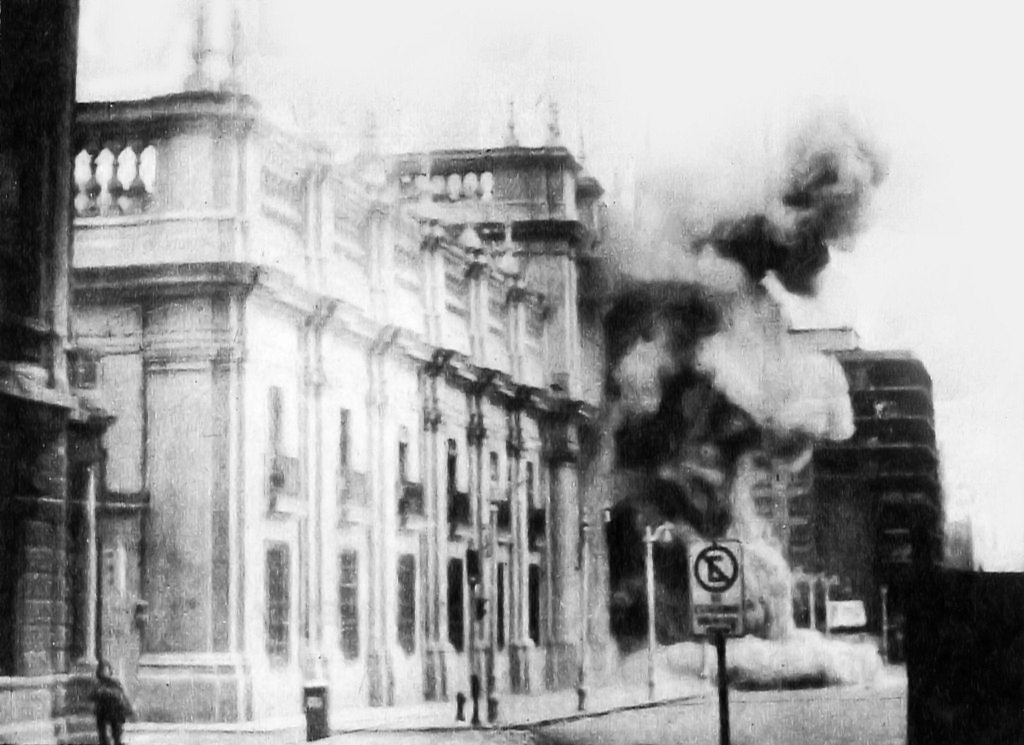
On 11 September 1973 the Chilean armed forces overthrew the elected government of Salvador Allende. Hawker Hunters struck La Moneda; Allende died in the palace -- suicide in the official and most historical accounts, a contested image in some memory camps. A junta headed in fact by General Augusto Pinochet closed Congress and began a dictatorship that lasted until 1990.
The coup followed three years of polarisation: Allende's Unidad Popular programme, economic crisis, the October 1972 strike, the Tanquetazo of June 1973, and a fractured military. US hostility to Allende (Track I/II in declassified files) is part of the context; it is not a complete remote-control explanation of 11 September. Chilean officers made the day.
Rettig and Valech commissions later documented thousands killed or disappeared and tens of thousands tortured. English-language memory arrives through Missing, The Battle of Chile, and 9/11 date-confusion with 2001. This page is political-military history -- causes, named actors, documented crimes -- not a manual for seizing a palace.
Day11 Sep 1973
PresidentSalvador Allende
Junta faceAugusto Pinochet
La MonedaBombed / stormed
Dictatorship1973-1990
Dead/disappearedthousands, official commissions
Profile
Scale
20
Intensity
55
Duration
35
Tech shift
15
Political impact
68
Cultural memory
62
Pin a cost beat to a legacy beat
On this topic, pick one published cost band and one legacy lesson already on the page. Educational pairing — not a nation league.
Documented ranges and memory notes only. No ranking of countries, peoples, or armed forces as teams. Not operational advice.
Cost beat already published
Legacy beat already published
Cost or lesson
Theme reading only. Not a nation league.
Deep introduction
A palace, a junta, and a long dictatorship
11 September was a day; the regime was seventeen years; the memory fight is still open in Chilean streets and US archives.
1970-73 polarisation
Allende won a plurality in 1970. Land reform, nationalisations, and a Cold War reading in Washington and in the Chilean right produced a pre-coup crisis, not a sudden whim.
The military's constitutionalist commander, General Prats, resigned in August 1973; Pinochet's rise was inside that vacuum.
The day
Navy, air force, and army moved. La Moneda was isolated and attacked. Allende's last broadcast is a primary source. This paragraph names a sequence; it does not teach one.
Foreign journalists and the stadium as a detention site entered the first week's record.
Dictatorship
DINA, exile, the 1980 constitution, the 1988 plebiscite that Pinochet lost -- a long afterlife of 11 September.
The 1990 concertacion transition left Pinochet as army commander for years -- an unfinished civilian control story.
Archives and film
US declassifications (especially 1999-2000s) thickened the embassy-and-Track file without erasing Chilean agency. Guzman's Battle of Chile remains the documentary canon in English art houses.
Archives and film stays dated: 1973-08 (Prats resigns) in Santiago and Chilean armed services; US political context. Jose T. Merino (Navy) is a named witness -- A junta principal; the navy's role on 11 September is part of the services' shared act. Cost band: Allende dead 11 Sep; later dictatorship killings and disappearances in the thousands (Rettig / Valech ranges). Encyclopedia, not a method.
United States militaryUS political context and declassified tracks -- influence, not a US troop landing.
Key terms
Unidad Popular
Allende's 1970-73 coalition government.
Tanquetazo
29 June 1973 failed armour revolt -- a preface.
La Moneda
The presidential palace attacked on 11 September.
DINA
The dictatorship's secret police in the early years.
Rettig / Valech
Official truth commissions on killing and torture.
Plebiscite 1988
The "No" that ended Pinochet's bid to stay.
Agency
Declassified US documents show hostility and contacts. They do not replace Chilean officers on 11 September.
Both sentences belong in the same history.
Economy and class
Inflation, shortages, and the truckers' strike were political facts, not only CIA talking points.
Reduce neither to "chaos" nor to a clean socialist martyrdom without the crisis file.
After the palace
The coup's meaning is the dictatorship's dead and the 1988-90 transition, not only the Hawker Hunter still.
Keep After the palace pinned to 1973-09+ (Stadium and DINA): Mass detention and the secret-police years. Chile 1973 coup remains a 11 September 1973 (coup day; dictatorship 1973-1990) file in Santiago and Chilean armed services; US political context, not a playbook.
20scaleEditorial 0-100 browsing score
55intensityEditorial 0-100 browsing score
35durationEditorial 0-100 browsing score
15techShiftEditorial 0-100 browsing score
Chile 1973 coup: concrete atlas depth on Tool-Lifes.
Frequently asked questions
Are the scores a ranking of nations or armies?
No. Scores are browsing aids inside an era-bounded atlas — not live league tables of countries.
How many were killed?
Allende on the day; thereafter thousands killed or disappeared (Rettig and later updates) and tens of thousands tortured (Valech). Use commission ranges, not a single slogan integer.
Did the United States run the coup?
The US government opposed Allende and the declassified record shows covert political action and contacts. The operation on 11 September was executed by Chilean services. Historians argue about degrees of involvement; they do not treat it as a US amphibious landing.
How did Allende die?
The consensus of official investigations and most historians is suicide during the attack on La Moneda. Some memory camps still dispute the image. This page follows the mainstream historical account and names the dispute.
What was the Tanquetazo?
A 29 June 1973 failed armoured rising -- a warning rehearsal, not the September coup itself.
When did the dictatorship end?
The 1988 plebiscite rejected Pinochet's continuation; Patricio Aylwin took office in 1990. Pinochet remained army commander until 1998.
Why is this in a war atlas?
Because coups are political-military events with force, dead, and afterlives -- recorded here as history, never as instruction.
Is this a how-to?
No. Sequences are named to explain a past crime and a past regime, not to reproduce them.