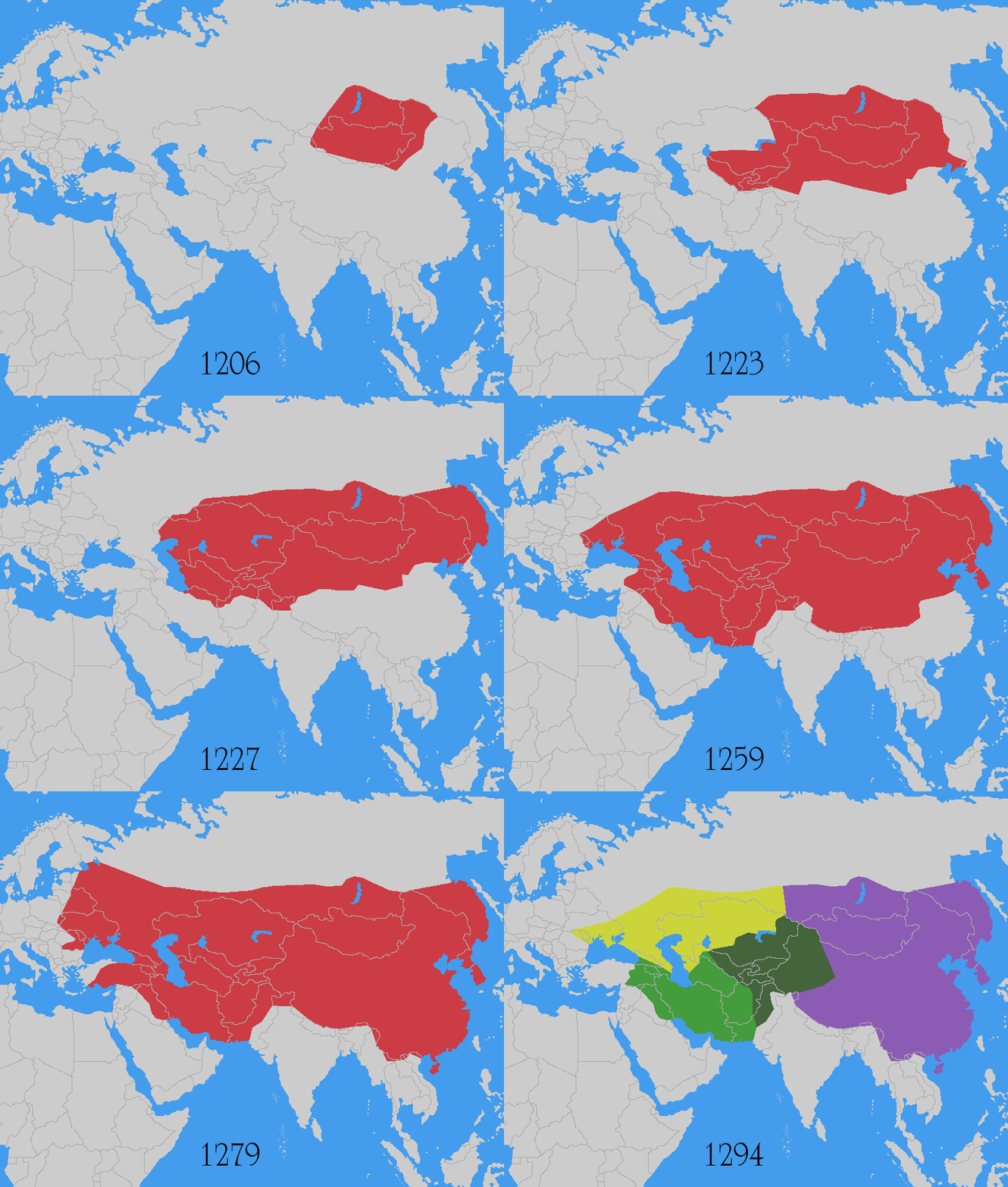
The Mongol conquests began as Temujin unified the steppe and took the title Chinggis (Genghis) Khan in 1206. Within two generations Mongol armies had broken the Jin and Western Xia, shattered Khwarezm, taken Kiev's political world, and ridden into Hungary and Poland (1241). The empire later split into khanates while Kublai Khan completed the conquest of Song China and founded the Yuan dynasty (1271).
Deaths are among the least certain in this atlas: published scholarly ranges often sit around 20-40 million across the thirteenth century, with some older figures higher and many local studies lower. Siege massacres (Baghdad 1258, Zhongdu, Nishapur in the chronicles) sit beside famine and displacement. Treat every total as a band, not a census.
The same empire that destroyed cities also ran relay posts (yam), protected some trade, and moved artisans and astronomers across Eurasia -- the "Pax Mongolica" of later textbooks. English memory arrives through Travels of Marco Polo, school maps of a pink-brown blob, and a thin film canon. Korean memory is more specific: the 1231-59 Goryeo wars and the forced 1274/1281 expeditions toward Japan.
Core spanc. 1206-1294
Deathsabout 20-40 million, uncertain
KarakorumImperial camp-capital
Baghdad sack1258
Japan typhoons1274, 1281
Yuan foundingKublai, 1271
Profile
Scale
85
Intensity
82
Duration
70
Tech shift
35
Political impact
80
Cultural memory
60
Pin a cost beat to a legacy beat
On this topic, pick one published cost band and one legacy lesson already on the page. Educational pairing — not a nation league.
Documented ranges and memory notes only. No ranking of countries, peoples, or armed forces as teams. Not operational advice.
Cost beat already published
Legacy beat already published
Cost or lesson
Theme reading only. Not a nation league.
Deep introduction
Steppe unification, city sieges, and a Eurasian afterlife
The Mongol wars were a technology of mobility and terror that became, in the successor khanates, a system of tax, post and pluralism -- at a demographic price still counted in ranges.
Unification and China
Chinggis's early wars were against steppe rivals, then Western Xia and Jin. The 1215 fall of Zhongdu (Beijing) is an early named urban catastrophe in the Chinese record.
Ogedei and later Mongke continued the China war; Kublai's Yuan was a conquest dynasty that also became a Chinese state.
The western explosions
The Khwarezm war (from 1219) after the Otrar incident produced the most famous massacre chronicles. Batu and Subutai's 1237-42 western campaign broke Volga Bulgaria and many Rus' cities and defeated European knights at Legnica and Mohi -- then withdrew when Ogedei died.
Hulagu's 1258 sack of Baghdad ended the Abbasid caliphate's old political theatre.
Limits
Ain Jalut (1260) stopped the Syrian advance. Japan survived two invasion attempts (1274, 1281) that Korean and Chinese shipyards were forced to support -- a Goryeo trauma as much as a Japanese typhoon legend.
Southeast Asia and Mamluk Egypt marked other edges of the project.
Split and memory
The Golden Horde, Ilkhanate, Chagatai Khanate and Yuan were successor politics, not one forever-army. Plague in the fourteenth century later moved along some of the same routes -- a debated link, not a slogan.
Modern national stories (Russia, Iran, China, Korea, Hungary) each keep a different Mongol.
A pre-gunpowder Eurasian conquest that later gunpowder empires and school maps still use as a scale marker.
See also
Chinese Civil WarMuch later; both decided who ruled China -- the Yuan was a conquest dynasty, 1949 a revolutionary one. Paired as China-rule turning points in this atlas.
Roman militaryAnother long imperial force structure; the Mongol case is mobility and a short political peak, Rome a centuries-long institution -- a contrast.
World War IIThe other "global" scale marker in this atlas; comparison is about reach, not about methods or morals equated.
12 December 1979 coupNo operational link -- related only through Korean historical memory of earlier foreign militaries on the peninsula, which Goryeo-Mongol wars inaugurate in a long series.
Key terms
Kurislt / kurultai
Assembly that chose and legitimated khans -- politics of the steppe state.
Yam
Relay-post system that moved orders and later some commercial traffic.
Decimal army
Arban/jagun/mingghan/tumen organisation -- named as history, not a drill book.
Khanate
Successor realms after the unified empire strained.
Pax Mongolica
Later label for mid-century security on some routes -- overused, not meaningless.
Kamikaze (1274/81)
Japanese name for the storms that wrecked invasion fleets -- a national myth with a real weather event and a Korean shipbuilding cost.
Terror as policy in the chronicles
Massacres after resistance are a repeated theme in Persian, Chinese and European sources. Historians argue about numbers and about when surrender brought protection.
This page records the debate. It does not teach a method of siege or slaughter.
Korea in the machine
Goryeo fought, submitted, rebelled, and was compelled to build ships for Japan. The Mongol century is a Korean political trauma, not a cameo.
Jeju and the southern coasts still hold archaeological traces of that ship war.
After the blob
Yuan China, Ilkhanid Iran, and the Golden Horde's tax on Rus' princes were different governments. "The Mongols" as a single actor fades after the 1260s.
Timur's later wars are a separate, also bloody, sequel -- not this page's last chapter.
85scaleEditorial 0-100 browsing score
82intensityEditorial 0-100 browsing score
70durationEditorial 0-100 browsing score
35techShiftEditorial 0-100 browsing score
Mongol conquests: concrete atlas depth on Tool-Lifes.
Frequently asked questions
Are the scores a ranking of nations or armies?
No. Scores are browsing aids inside an era-bounded atlas — not live league tables of countries.
How many died?
About 20-40 million is a commonly cited scholarly-range band across Eurasia, with very high uncertainty. Some local chronicle figures are impossible as censuses. Use ranges.
Did they "conquer the world"?
They built the largest contiguous land empire, then stopped or failed at Japan, the Mamluk Levant, and parts of Southeast Asia. Sea and desert edges mattered.
What was Baghdad 1258?
Hulagu's forces took the city and ended Abbasid caliphal rule there. Chronicle death figures are huge and disputed; the political shock is not.
How was Korea involved?
Mongol campaigns against Goryeo ran through the 1230s-50s. Later, Goryeo was forced to support Kublai's Japan expeditions of 1274 and 1281 -- a Korean tragedy inside a Japanese legend.
What is Pax Mongolica?
A later phrase for relative security on some overland routes in the mid-to-late thirteenth century. It does not cancel the conquest deaths.
Why did the western campaign of 1241 stop?
Ogedei's death and the politics of succession pulled princes back. Europe was not "saved" by a single knightly virtue in serious accounts.
Is this a how-to of nomadic war?
No. This is an encyclopedia of a historical empire. It does not teach raiding, siege, or command.