Colonial cabinets
Named shock
Linnaeus and travellers treated a river fish as a spark exhibit.
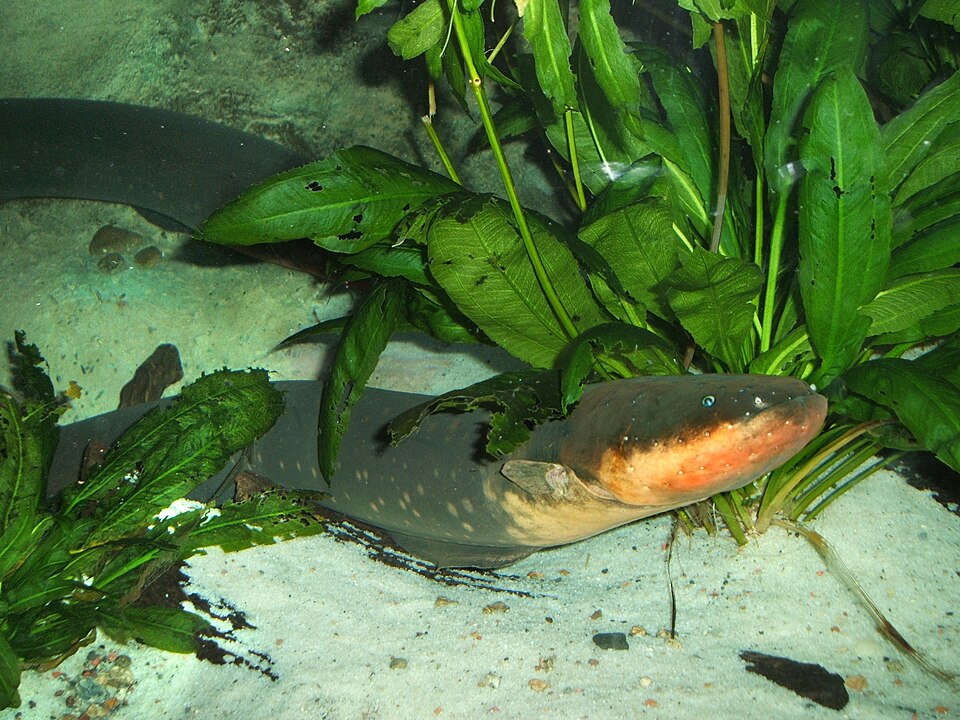
Electric eel · Amazon knifefishes whose stacked electrocytes taught Humboldt, Volta arguments and a 2019 species split.
Milestones in order. This is history, not a weekly activity grid.
Darker cells mean a higher score for this topic on that metric.
LessMore
Last reviewed Sources & creditsMedia creditsMethodology
No. It is a gymnotiform knifefish. The body plan and voltage organ are South American, not Anguilliform.
A 2019 Nature Communications paper split Electrophorus into three: E. electricus, E. voltai and E. varii. Voltage and DNA both argued for the split.
E. voltai has been measured near 860 V. That is a prey-stun and defence pulse, not a household-current analogy that holds in every tank.
His account of horses herded into a pool of eels became a European science anecdote. Later readers treated it as a method; it was also travel theatre.
Volta and Galvani debates used animal electricity. Electrophorus was a New World exhibit in that argument, not the sole inventor of the pile.
A high-voltage volley can freeze prey; a weaker field maps the night water. Kenneth Catania high-speed videos in the 2010s showed doublets that twitch hidden fish.
The electric eel did not enter English as a finished emblem. Hunts, films, listings and field stations rewrote the animal on a dated clock.
This chapter keeps ten timeline points, five eras and three milestones so a later translation can hold the same years.
The shock fish entered binomials from colonial specimens.
Travel narrative that locked the eel into European electricity lore.
The battery argument used animal electricity as a foil -- eels in the same conversation.
Anatomists mapped the stacked electrocyte columns that physics later modelled.
Electrophysiology used the organ as a giant axon-adjacent preparation.
Vanderbilt high-speed work showed remote twitch and double-pulse hunting.
de Santana et al. named E. voltai and E. varii beside E. electricus.
E. voltai measurements reset the popular 600 V ceiling.
Amazon hydropower papers began listing gymnotiforms among fragmented river fauna.
Large Electrophorus still move as novelties; LC status is not a shipping brief.
Linnaeus and travellers treated a river fish as a spark exhibit.
A horse story and a pile put the eel inside electricity history.
Anatomy then electrophysiology used stacked cells as a lab.
Catania hunts and a three-species paper rewrote the textbook singular.
Hydropower and the pet trade are the unromantic files.
A travel scene became the default European eel story.
Hunt kinematics moved from anecdote to milliseconds.
One famous fish became three -- voltage included.
Reading electric eel history beside the resilience score keeps a recovered stock from standing in for a threatened cousin.
Apex lamnid whose warm muscle, broad diet and 1975 cinema still outrun the tagging papers.
Overall 66 🐟Anadromous fishes that move ocean fat onto spawning gravels -- and into forests, treaties and hydropower fights.
Overall 63 🐟A warm-bodied tuna whose Tokyo auction prices and ICCAT quotas made a single fish into a geopolitical unit.
Overall 54 🐠Anemone-dwelling damselfish whose 2003 film fame became a capture-and-reef case study.
Overall 41 🐴Male-pregnancy fish — Hippocampus since Linnaeus (1758), dried trade, and CITES Appendix II (2002).
Overall 28 🎏Domesticated carp whose Niigata colour mutations became a global pond aesthetic -- not a wild goldfish substitute.
Overall 42 🐡Beak-toothed inflators whose tetrodotoxin made a Japanese cuisine and a genome project out of one family.
Overall 41