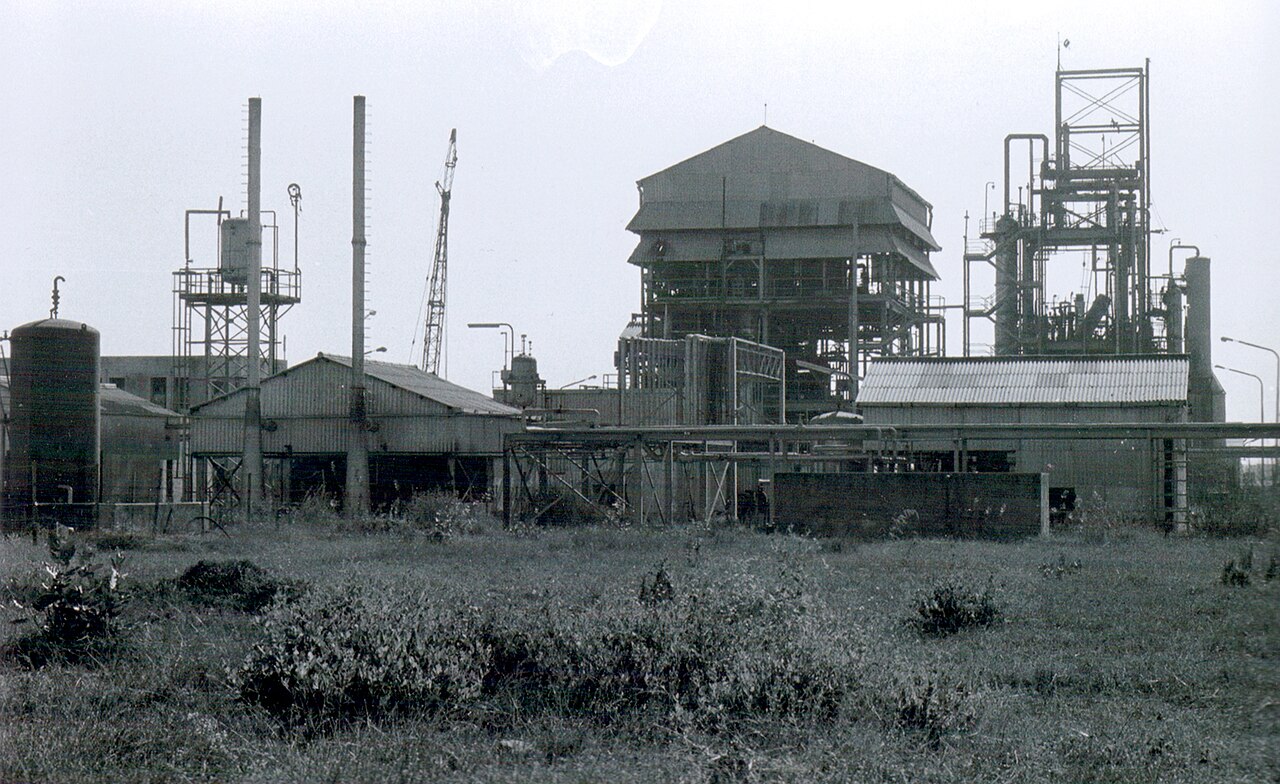
On the night of 2–3 December 1984 a methyl isocyanate leak at the Union Carbide plant in Bhopal killed thousands and left a mixed legal record that still shapes industrial-disaster law.
Also called: Union Carbide gas leak · Bhopal methyl isocyanate
At a glance
Score intensity
Darker cells mean a higher score for this topic on that metric.
Notoriety88
Mystery22
Scale96
Evidence70
Legal impact72
Culture68
LessMore
Score profile
Each bar is a 0-100 atlas score for this topic, not a timeline.
Notoriety88
Mystery22
Scale96
Evidence70
Legal impact72
Culture68
Evidence
Evidence
70%
Score profile
Mystery
22%
Timeline
Milestones in order. This is history, not a weekly activity grid.
On the night of 2–3 December 1984, methyl isocyanate (MIC) escaped from Tank 610 at the Union Carbide India Limited pesticide plant in Bhopal, Madhya Pradesh. The official immediate death toll recorded in early government figures was 2,259. Later Indian government statements used about 3,500 deaths within days and more than 15,000 gas-related deaths over subsequent years; campaign groups have published still higher totals. This page dates those figures and does not describe injuries.
Union Carbide Corporation of the United States and the Union of India settled civil claims for US$470 million in February 1989, a sum the Supreme Court of India approved and later revisited. Criminal charges against Indian UCIL officials were reduced in 1996 from culpable homicide to causing death by negligence (IPC section 304A). On 7 June 2010 a Bhopal court convicted seven former employees and the Indian company, imposing two-year terms and fines. Warren Anderson, UCC’s American chief executive, was arrested in 1984, released on bond, left India and was never extradited.
Status is mixed because a civil settlement and limited criminal convictions sit beside an unfinished site-cleanup and unfinished arguments about parent-company duty. Dow Chemical’s 2001 acquisition of UCC inherited a legal dispute, not a closed moral ledger. English-language memory treats Bhopal as the type case of a poor neighbourhood next to a rich company’s tank.
Date2–3 Dec 1984
PlantUCIL / Union Carbide
Immediate deaths2,259 official
Settlement$470m (1989)
Criminal lawIPC 304A, 2010
StatusMixed / open site
Dossier scores
Notoriety 88
Mystery 22
Scale 96
Evidence 70
Legal impact 72
Culture 68
Notoriety
88
Mystery
22
Scale
96
Evidence
70
Legal impact
72
Culture
68
A leak, a settlement and a thin conviction
Bhopal is the public-record industrial disaster that industrial-accident law still cites when parent companies, host states and neighbours do not share a courtroom.
A pesticide plant inside a city
UCIL, majority-owned by Union Carbide Corporation, made carbamate pesticides at Bhopal. The MIC unit dated from the late 1970s. By 1984 the plant sat beside densely inhabited wards. Safety systems on Tank 610 — refrigeration, scrubbing, flaring — were not in the state the design assumed, according to later Indian investigation and civil discovery.
Water entering the MIC tank is the physical trigger most official reconstructions accept. How the water got there, and how far that question matters beside disabled safeguards, remains a secondary argument. This page does not reconstruct a method. The public fact is an uncontrolled release over sleeping neighbourhoods.
Counts that never became one number
Hospitals and municipal cremation grounds were overwhelmed on 3 December. The first official immediate count, 2,259, is still the figure many legal summaries use for the night itself. A 2006 government affidavit and later health-department statements raised injury counts above 500,000 and later death attributions into five figures.
Indian Council of Medical Research studies and independent clinics documented chronic illness in exposed wards. English sources that print a single “20,000 dead” without a date are collapsing advocacy totals with the 1984 municipal count. Responsible reference keeps the night, the decade and the model separate.
Civil peace, criminal remainder
The Bhopal Gas Leak Disaster (Processing of Claims) Act 1985 made the Union of India the exclusive representative of claimants. After failed United States forum litigation, the Supreme Court on 14–15 February 1989 recorded a US$470 million settlement and, in the first order, also quashed criminal cases — a step later undone after protest.
In 1996 the Supreme Court reduced the Indian accused’s charges to IPC 304A, a two-year maximum. The June 2010 convictions were the first criminal judgments against UCIL officials. Anderson remained an absconder in the Indian file. Dow’s position is that the 1989 payment closed UCC’s civil liability; many Bhopal groups reject that reading.
Law written after the leak
India’s Environment (Protection) Act 1986 and the Public Liability Insurance Act 1991 are the domestic statutory aftershocks: central environmental power and no-fault industrial insurance. The United States Emergency Planning and Community Right-to-Know Act 1986 is often taught in English as Bhopal’s American cousin, though its legislative history also includes domestic chemical incidents.
The plant site’s remaining waste and groundwater claims are a living environmental case. Mixed status means the encyclopedia must hold three files at once: a paid civil settlement, a 2010 negligence conviction, and an unfinished contaminated site.
Beat weight marks
Mark each timeline beat already on this dossier as supported, contested or unknown, using the public-record claims already filed here. Not a verdict.
Editorial marks on this device only. Public-record encyclopedia — not legal advice, not a how-to, not a private file.
Timeline beat
Supported / Contested / Unknown
1969 — UCIL plant at Bhopal
Claim already on file: A single official total is 20,000 dead on the night.
1979–80 — MIC unit in service
Claim already on file: No one was ever convicted.
2–3 Dec 1984 — Tank 610 release
Claim already on file: The 1989 payment was secretly imposed without a court.
Dec 1984 — Anderson arrested, released
Claim already on file: The cause of the leak is unknown.
1985 — Claims Act
Claim already on file: The cause of the leak is unknown.
1986 — Environment (Protection) Act
Claim already on file: The cause of the leak is unknown.
14 Feb 1989 — $470 million settlement
Claim already on file: The cause of the leak is unknown.
1996 — Charges reduced to 304A
Claim already on file: The cause of the leak is unknown.
2001 — Dow acquires UCC
Claim already on file: The cause of the leak is unknown.
7 Jun 2010 — Bhopal convictions
Claim already on file: The cause of the leak is unknown.
Methyl isocyanate from a storage tank at the UCIL pesticide plant on the night of 2–3 December 1984. The page does not discuss how to handle or release the chemical. The public fact is an uncontrolled urban exposure.
How many people died?
The official immediate death toll often cited is 2,259. Indian government statements later used about 3,500 deaths in the first days and more than 15,000 gas-related deaths over the following years. Campaign estimates run higher. All of these are dated published figures, not a single census.
What was the 1989 settlement?
UCC paid US$470 million to the Union of India under Supreme Court orders of 14–15 February 1989 to resolve civil claims. Criminal proceedings were first quashed and later revived. Distribution of the money to claimants took years and remains criticised.
Who was convicted?
On 7 June 2010 a Bhopal court convicted seven former UCIL officials, including chairman Keshub Mahindra, and the Indian company of causing death by negligence (IPC 304A) and related counts. Sentences were two years and fines. An eighth accused had died. Warren Anderson was not in the dock.
Why is the status “mixed”?
Civil claims were settled; criminal law produced only negligence convictions of Indian employees; the American parent executive was never tried in India; the factory site’s contamination file is not closed. Those outcomes do not add to a single word like convicted or closed.
What Indian laws followed?
The 1985 claims-processing Act, the Environment (Protection) Act 1986 and the Public Liability Insurance Act 1991. Together they centralised claimant representation, environmental rule-making and no-fault industrial insurance.
Did Dow Chemical become liable?
Dow bought UCC in 2001 and states that the 1989 settlement ended UCC’s civil liability. Indian courts and campaigners have continued to test whether a successor or the former parent still owes cleanup or further damages. That dispute is why the aftermath stays open.
Is the cause unknown?
No. An MIC release from Tank 610 is not in doubt. Arguments about sabotage versus water ingress and disabled safeguards are secondary. Mystery is low; legal finality is mixed.