c. 6000 BCE
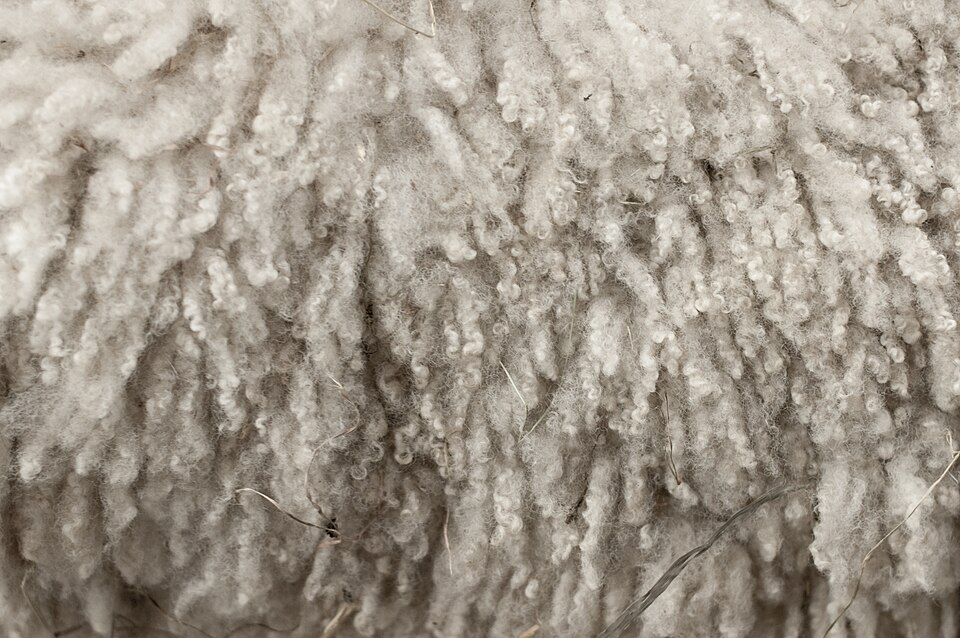
Woolly sheep
Selective breeding for fleece after hair sheep.
Wool · Crimped keratin that traps still air — suiting, carpets and a quietly decent fire story among apparel fibres.
Milestones in order. This is history, not a weekly activity grid.
Darker cells mean a higher score for this topic on that metric.
LessMore
Last reviewed Sources & creditsMedia creditsMethodology
Declared reaction class in this atlas: better than commodity synthetics in many apparel tests. Assemblies still need resistance tests.
Thermal mark 72/100 versus the atlas. Conductivity note: low when lofted.
~1.31 g/cm³
Origin story: Neolithic sheep; merino Spain; industrial Yorkshire (Near East → Spain → Australia).
Circularity mark 58/100 — editorial, route-specific.
chars; does not melt-drip like PE
heat 38 · fire 48
Wool did not arrive as a finished commodity. Neolithic sheep; merino Spain; industrial Yorkshire around Near East → Spain → Australia still explains who makes it and which tests it sits in.
Ten dated points, five eras and three milestones below are the spine — not a complete industrial history.
Selective breeding for fleece after hair sheep.
Wool customs funded states; Flanders wove it.
Fine-wool monopoly until flocks spread.
Colonial flocks became the fine-wool engine.
Bradford combed yarns vs carded woollens split the trade.
Chlorine-Hercosett made machine-wash wool possible — and AOX debates later.
IWTO branding against polyester’s rise.
Finer than 18 µm became a fashion spec.
Animal-welfare specs entered brand RFQs.
Outdoor brands rediscovered wool as a non-stink base layer.
Selective breeding for fleece after hair sheep.
Fine-wool monopoly until flocks spread.
Bradford combed yarns vs carded woollens split the trade.
IWTO branding against polyester’s rise.
Animal-welfare specs entered brand RFQs.
Colonial flocks became the fine-wool engine.
IWTO branding against polyester’s rise.
Outdoor brands rediscovered wool as a non-stink base layer.
Knowing this timeline is how to read a mill certificate without treating Wool as timeless.
Seed-hair cellulose that dressed the industrial revolution — still the comfort fibre of daily wear.
Overall 44 🦋A kilometre-class animal filament — luxury cloth, sutures and a template for bio-inspired fibres.
Overall 41 🎽The dominant apparel polymer — bottle-grade PET spun into staple that dries fast and sheds microfibres.
Overall 49 🪢Carothers’ polyamide — stockings, tyre cord, climbing rope and a melt-drip fire personality.
Overall 48 🦺Aromatic polyamide pulps and filaments — ballistic packs, hot-gas filtration and asbestos replacement.
Overall 62