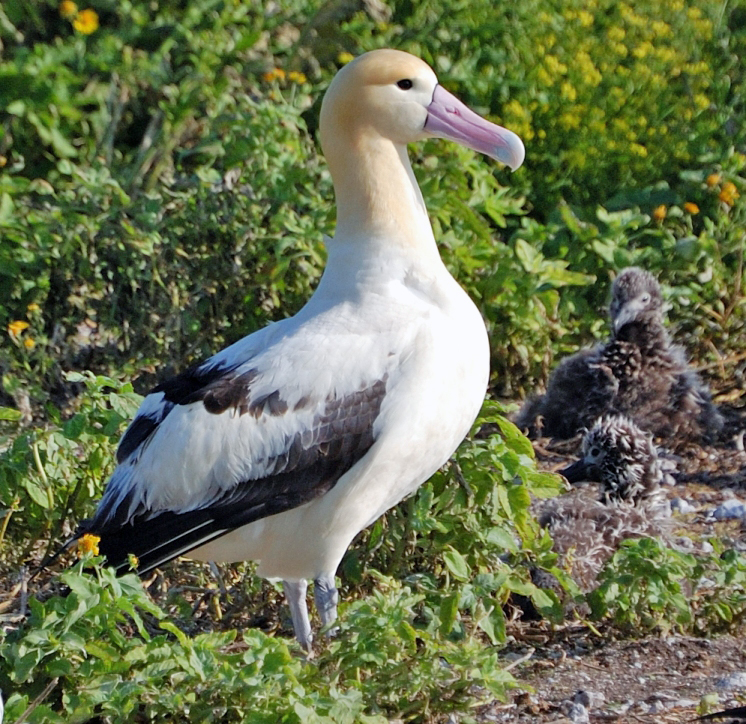
Sail and poem
Mariner’s bird
Sailors read albatrosses as weather and omen; Coleridge locked the omen into English verse.
Albatross · Dynamic-soaring ocean birds whose metres-long wings and baited longlines now share the same latitudes.
Milestones in order. This is history, not a weekly activity grid.
Darker cells mean a higher score for this topic on that metric.
LessMore
Last reviewed Sources & creditsMedia creditsMethodology
The bird climbs and dives through wind-speed gradients above waves, converting shear into airspeed. Heart-rate loggers show travel costs closer to rest than to flapping flight.
A female banded in 1956 by Chandler Robbins at Midway. She has fledged chicks into her seventh decade — a longevity record that made a single band number famous.
Baited hooks look like squid. One set can kill dozens of birds. Night setting, weighted lines and tori lines cut the kill when fleets actually use them.
The 1798 Rime made killing an albatross a moral crime. The poem outran the biology and still titles newspaper bycatch stories.
The northern royal albatross colony near Dunedin is a mainland breeding site with public hides — rare for a family that usually needs remote islands.
On Gough and some other islands, introduced house mice attack chicks of albatrosses and petrels. Eradication attempts are now as central as hook rules.
The albatross did not enter English as a finished emblem. Hunts, films, listings and field stations rewrote the animal on a dated clock.
This chapter keeps ten timeline points, five eras and three milestones so a later translation can hold the same years.
Oligocene fossils already show long-wing ocean wanderers.
Coleridge’s poem made the albatross a guilt object in English.
Chandler Robbins bands a Laysan female at Midway — later the longevity celebrity.
Tuna and toothfish fleets scaled baited hooks across Southern Ocean forage zones.
Early mandatory streamer-line rules in the toothfish fishery.
Cape Town agreement created a species-specific treaty for albatrosses and petrels.
Chick deaths from paint chips pushed a cleanup of WWII buildings.
RSPB-led eradication designs treated mice as apex predators on a seabird island.
USFWS notes on another Midway chick kept the 1956 band in headlines.
A major mouse-drop operation showed both the scale and the setback risk of island eradications.
Sailors read albatrosses as weather and omen; Coleridge locked the omen into English verse.
A 1956 band turned longevity from sailor talk into a table.
Tuna and toothfish hooks became the leading documented killer.
A treaty, tori lines and night-setting codes tried to make mitigation ordinary.
Island predators and gyre plastic joined hooks on the threat list.
A dedicated international agreement — rare for a bird family.
One Laysan female made seabird longevity a public number.
Streamer lines moved from experiment to fishery licence conditions in several oceans.
Reading albatross history beside the resilience score keeps a recovered stock from standing in for a threatened cousin.
Apex diurnal raptors whose stoops, territories and national emblems stretch from taiga cliffs to tropical canopy.
Overall 75 🦉Nocturnal raptors whose facial discs, silent flight and asymmetric ears turn darkness into a hunting map.
Overall 72 🐧Flightless southern divers that turned wings into flippers and ice edges into commute routes.
Overall 56 🐦New World nectar specialists that hover on figure-eight wings and migrate on a few grams of fat.
Overall 63 🦩Long-legged filter feeders whose bent bills and carotenoid diets turn alkaline lakes into pink cities.
Overall 52 🦜Zygodactyl hookbills whose social brains, mimicry and nest-cavity needs collide with the cage trade.
Overall 58 🦢Tall wetland dancers whose red-crowned East Asian population is the atlas type and a conservation bottleneck.
Overall 53