Post-surgical amnesia risk
Bilateral MTL damage can devastate new learning.
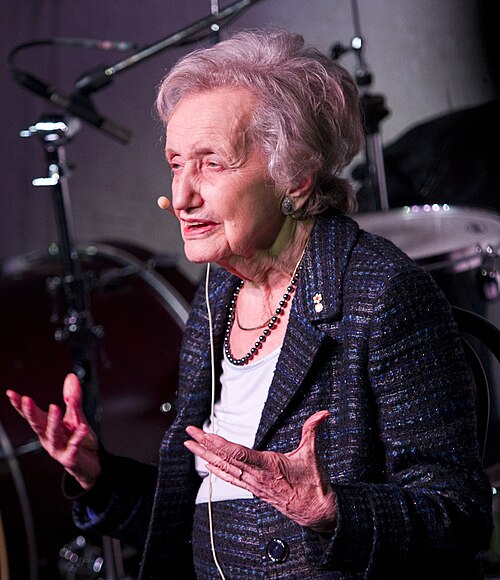
Brenda Milner · Cognitive neuroscience pioneer — patient H.M., memory systems and the lasting lesson that lesions can dissociate what looks unified.
Reviewed 2026-08·Sources & research·Methodology·Media credits
Darker cells mean a higher score for this topic on that metric.
LessMore
Last reviewed Sources & creditsMedia creditsMethodology
Henry Molaison (1953 bilateral medial temporal surgery). He lost new episodic memory while retaining skills — the dissociation that remade memory science.
1957. The paper tied hippocampal removal to anterograde amnesia without collapsing language or IQ in the teaching summary.
H.M. improved at mirror-tracing across days without remembering the sessions — procedural skill without episodic recall.
No. History of published cognitive neuroscience. Not medical advice, diagnosis, or surgical counsel.
Montreal Neurological Institute — careful testing, frontal-lobe work, and mentorship alongside the H.M. archive.
Hippocampus (memory index) and frontal lobes (control). Use dual-view; do not invent a personal lesion map.
Clinical relevance today includes counselling about memory risk in temporal surgery, neuropsychology assessment and ethical standards shaped by historical cases.
Educational history of neuroscience — not medical advice. Patient identities and clinical details are discussed at the level of published science.
Bilateral MTL damage can devastate new learning.
Context for many historical and modern surgical cases.
Later syndromes echoing selective memory loss themes.
Clinical memory failure with overlapping anatomy lessons.
Milner’s broader testing tradition beyond H.M.
Honest talk about irreversible cognitive change.
Inability to form lasting new episodic memories.
Improvement on procedural tasks without recall.
Speech and comprehension largely intact in H.M.
How remote memory holds after MTL injury.
Need for external memory supports after dense amnesia.
Discuss risks with epilepsy surgery candidates carefully.
Quantify declarative vs procedural profiles.
External scaffolds for anterograde gaps.
Modern safeguards informed by historical cases.
Historical cases inform care; they do not replace individual clinical judgement.
The neuron doctrine — drawing the brain cell by cell.
Research 58 🗣️Speech production and the birth of modern localization.
Research 69 👂Comprehension aphasia and the language network idea.
Research 58 🗺️Cortical maps from the operating room — the sensory homunculus.
Research 85 👁️How visual cortex builds edges, columns and critical periods.
Research 58 🐌Learning as synaptic change — from Aplysia to human memory.
Research 93 ❤️Feeling, self and somatic markers in decision circuits.
Research 78 🎨Vision, art and how cortex separates colour, form and motion.
Research 74 🧪Nerve growth factor — discovering how neurons survive and wire.
Research 97 🗺️Place cells and the cognitive map inside the hippocampus.
Research 51