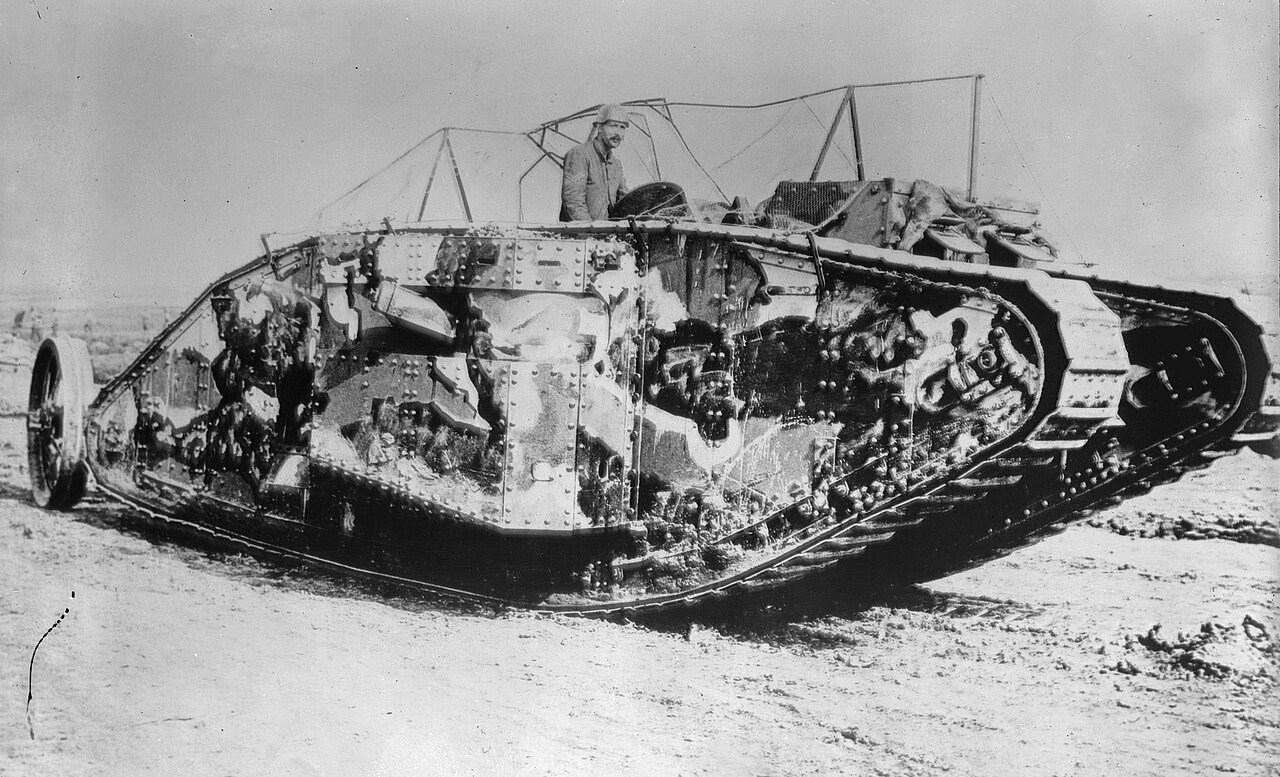
The tank appeared as a British attempt to cross 1916 trench ground: Mark I machines at Flers-Courcelette on 15 September 1916. The cover name "tank" stuck. France's Schneider and Saint-Chamond, then the Renault FT (turret, rear engine), set a layout the twentieth century would repeat. This page is the history of a type -- employment in wars as recorded fact -- not a design or driving manual.
Interwar theorists (Fuller, Liddell Hart, Guderian, Tukhachevsky, de Gaulle) argued whether armour was an infantry helper or a decisive arm. 1939-41 seemed to answer; 1943-45 and later 1973 (Sinai) reopened the argument with guns and missiles. The main battle tank of the Cold War (Centurion, T-54/55, M60, Leopard 1/2, M1) was an industrial-political object as much as a vehicle.
Cultural memory is thick: war-film silhouettes, model kits, and "tankie" as a later political insult. Korean memory includes the T-34 in 1950 and the later K1/K2 as ROK industry. Intensity in this atlas is moderate -- a weapon type, not a world war -- while techShift is high. No paragraph here is a how-to for armour employment.
DebutSomme, 15 Sep 1916
NameBritish "tank" cover story
InterwarFuller / Guderian debates
1940-45Type's industrial peak
PostwarMBT as a category
TodayContested by missiles and drones -- historically
Profile
Scale
50
Intensity
45
Duration
78
Tech shift
80
Political impact
48
Cultural memory
70
Pin a cost beat to a legacy beat
On this topic, pick one published cost band and one legacy lesson already on the page. Educational pairing — not a nation league.
Documented ranges and memory notes only. No ranking of countries, peoples, or armed forces as teams. Not operational advice.
Cost beat already published
Legacy beat already published
Cost or lesson
Theme reading only. Not a nation league.
Deep introduction
From a Somme secret to a contested type
The tank is a hundred-year argument about whether protected mobility still decides ground war -- told as history.
1916-1918
Mark I to FT: reliability was the scandal, not the idea. Cambrai (1917) and 1918 combined arms are the first "tank battle" stories -- dated, not copied.
Germany's late A7V was a footnote; anti-tank rifles were already a reply.
1939-1945
Panzer divisions, T-34, Sherman, and the Eastern Front's densities. Kursk is the popular caption; logistics and numbers are the quieter story.
This is wartime use as recorded, not a blitzkrieg recipe.
Cold War MBT
NATO and Warsaw Pact types as industrial alliances. The 1973 war's ATGMs entered every staff college paragraph -- historically.
Korea's K1 (with US design roots) and later K2 are a ROK industrial chapter.
After 2000
Asymmetric wars, urban fights, and drones reopened "is the tank dead?" -- a cyclical headline since 1918. History's answer has been: not dead, not sufficient.
No current ORBAT or vulnerability cookbook belongs here.
Missiles that recast 1973 staff talk -- named, not instructed.
K2 Black Panther
ROK late type -- an industrial fact.
Name as cover
"Tank" was a shipping lie that became the world's word.
Language is part of the history.
Theory wars
Infantry-support vs independent arm -- an interwar fight that 1940 did not permanently settle.
Missiles and drones are later verses of the same poem.
Industry is the type
Without factories there is no "tank arm." Hanwha and Rheinmetall belong in the cousin pages.
Keep Industry is the type pinned to 1943 (Kursk caption): Density and myth. Tank remains a 1916-present (as a type) file in From the Somme to every later armoured front, not a playbook.
50scaleEditorial 0-100 browsing score
45intensityEditorial 0-100 browsing score
78durationEditorial 0-100 browsing score
80techShiftEditorial 0-100 browsing score
Tank: concrete atlas depth on Tool-Lifes.
Frequently asked questions
Are the scores a ranking of nations or armies?
No. Scores are browsing aids inside an era-bounded atlas — not live league tables of countries.
Who "invented" it?
A British committee (Swinton, Tritton, Wilson and others) and parallel French work. There is no single Edison. The cover name came from industrial disguise.
Did tanks win the First World War?
They helped in 1918 combined arms. They did not win alone. Mechanical failure was common in 1916-17.
What is an MBT?
A Cold War idea that one "main" tank should replace light/medium/heavy splits. Centurion and T-54 are early exhibits.
Are tanks obsolete?
A headline since 1918, 1973, and the 2020s. History shows adaptation, not a funeral -- and this page will not umpire a current war.
How does Korea fit?
T-34s in 1950; then a ROK armour force and K1/K2 industry. See also the ROK military and Hanwha pages.
Why is the Tiger so famous?
German wartime propaganda and later hobby culture. Production numbers were small beside T-34 and Sherman.
Is this a how-to?
No. No armour layout, weak-spot, or driving content. History of a type only.