Pin the doneness and method you just left against the pick on this cut’s sheet. Last-versus-now stays on this device — teaching temperatures, not a diagnosis.
Not medical advice, a food-safety certificate or a guarantee. Use the published sheet temps and your own thermometer.
Last cook—
This cook—
Cook sequence from this cut sheet
Follow published Ribeye — teaching, not a thermometer app.
Name the cut — Confirm Ribeye on the sheet.
Pick doneness — Target Medium rare ~57°C.
Pair first method — Lead with Grilling.
Keep safety note — Stop where the fat has just begun to render. The thicker the steak, the more a three-minute rest protects it.
Last-vs-now is a pin — Cook-pair is a bookmark, not a certificate.
Ribeye: Medium rare (57°C) via Grilling.
Editorial butchery teaching only. Not HACCP or medical advice.
Substitute cut and safety stop
After the cook sequence for Ribeye, a second sheet pass: published swap cut plus the safety line already on this page.
Name the printed substitute — If Ribeye is missing at the counter, the sheet points to related cut Striploin — same atlas, not inventing a new primal.
Check shared method fit — Prefer a published method that still fits the substitute; lead method on this sheet is Grilling.
Hard stop on safety — Stop where the fat has just begun to render. The thicker the steak, the more a three-minute rest protects it.
Keep cook-pair as a pin — Saving a cook-pair bookmarks this sheet; it is not a food-safety certificate.
Ribeye → swap toward Striploin; stop on the printed safety line before plating.
Editorial butchery teaching only. Not HACCP or medical advice.
Cook, swap, or skip
Kitchen teaching. Not a food-safety certificate.
Doneness and method on this cut
What temperature does this page recommend for this cut?
The cut sheet already prints 54–57°C (Medium rare) for Ribeye. That is the published recommendation on this page, not a live thermometer reading.
Which cooking method fits this cut?
This sheet lists Grilling · Steak · Hot pot with fitness scores. Pair one of those methods with a doneness from the published scale (Blue 46 C through Well done 77 C). The cook-pair block pins last versus now — teaching, not a diagnosis.
Can I serve this cut pink?
Follow the sheet note already on this page: Stop where the fat has just begun to render. The thicker the steak, the more a three-minute rest protects it. Connective-tissue cuts ask for time; tender steaks ask for a rest after the published temp. The safety note at the bottom still applies.
Is the doneness scale a food-safety certificate?
No. The pair tool and the recommended temp are teaching numbers from this atlas. Use the printed sheet and your own thermometer. This page is not a medical or hygiene certificate.
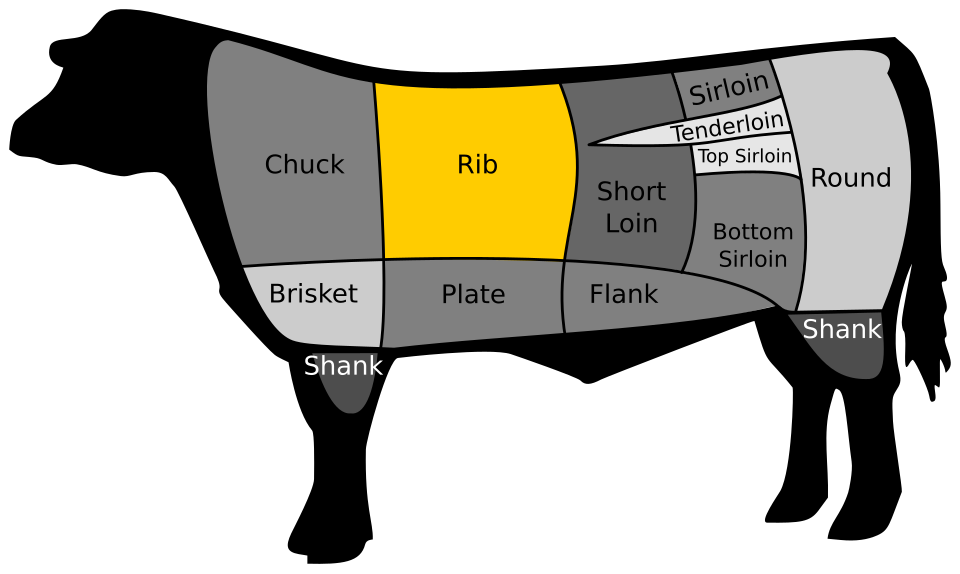
JoeSmack · Public domain
The muscle sitting over ribs six to eight. It barely moves during the animal's life, so the grain stays fine and intramuscular fat settles through it in a dense web. This is where the most spectacular marbling on any carcass appears.
Profile
Tenderness88
Marbling94
Umami82
Price90
Pairs with
Grilling95
Steak88
Hot pot40
Recommended cooking
54–57°CMedium rare
Stop where the fat has just begun to render. The thicker the steak, the more a three-minute rest protects it.
How to pick it
The best pieces carry fine marbling all the way out to the fat cap around the spinalis, not just in the eye.